

TL;DR: Financial anxiety isn’t about how much money you have; it’s about never feeling secure no matter how much you earn. This post explains what financial anxiety actually is, why high-earning professionals are especially vulnerable, what drives it beneath the surface, and what treatment approaches go beyond budgeting to address the root cause.
You earn six figures. Your retirement accounts are funded. Your emergency savings exist. On paper, you’re doing everything right financially.
So why do you feel anxious about money even though you have enough?
You refresh your investment accounts obsessively. You feel guilty spending on yourself. You lie awake calculating worst-case scenarios, even though you have 18 months of savings. You know your worry is irrational, but you can’t stop.
This is what financial anxiety looks like. And it’s not about your bank balance. It’s about your nervous system.
DISQUALIFIER:
A quick note before we continue:
This guide is for professionals who are financially stable but don’t feel secure. If you’re struggling to cover basic expenses or pay bills, you need financial counseling or crisis support first, not information about anxiety management.
This is about the psychological patterns that persist despite financial success, what researchers call financial anxiety despite being financially stable.
What Is Financial Anxiety vs. Financial Stress?
So what is financial anxiety, and how is it different from regular financial stress?
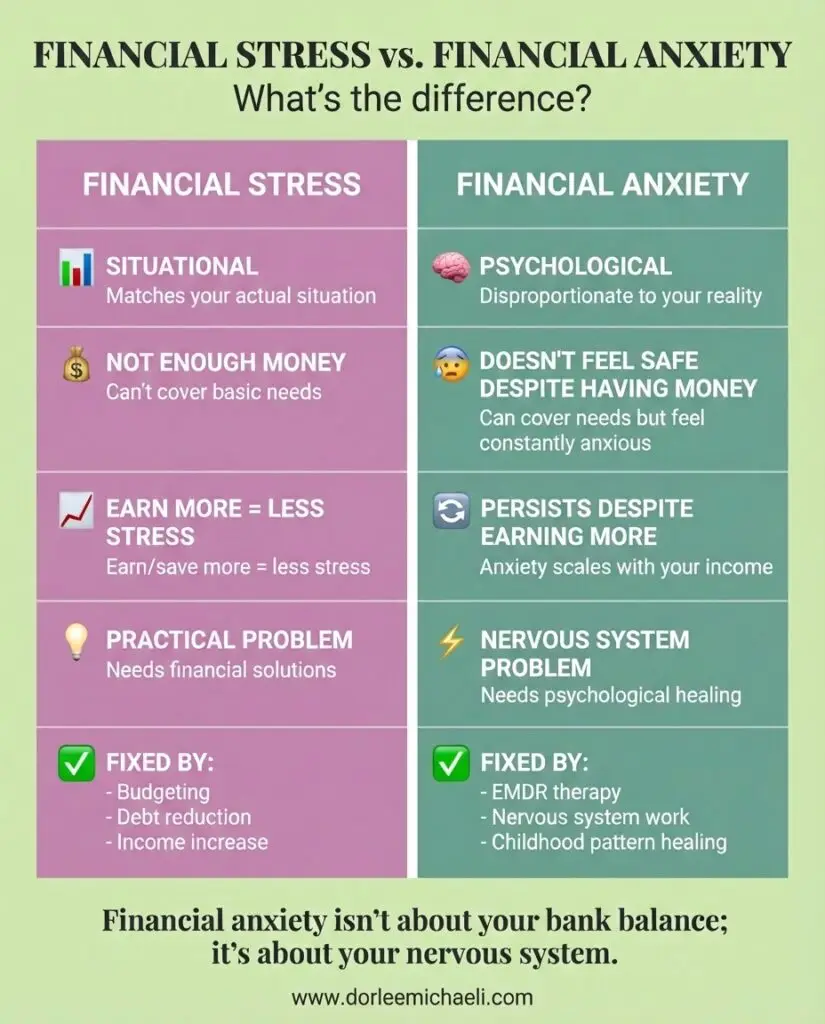
Financial stress happens when you don’t have enough money to cover your needs. It’s a practical problem that requires practical solutions such as budgeting, debt management, and increasing income. Financial stress is situational and proportionate to your actual financial circumstances.
Financial anxiety happens when you have enough money, but your nervous system doesn’t believe it. It’s a psychological problem that requires psychological solutions. Financial anxiety persists regardless of your objective financial situation.
This is what financial social work addresses. Reeta Wolfsohn, founder of the Center for Financial Social Work, describes it clearly: “Financial social work addresses the emotional, psychological, and relational aspects of money—not the technical aspects. It’s about helping people understand why they do what they do with money, not just what they should do.”
As a Financial Social Worker and EMDR therapist, I specialize in the intersection of money psychology and nervous system healing.
Research from the American Psychological Association shows that money is consistently the top source of stress for Americans, but importantly, money anxiety doesn’t correlate directly with income level. People earning $100,000+ report financial anxiety at similar rates to those earning far less, suggesting the issue is psychological rather than purely circumstantial.
The key difference: Financial anxiety adjusts to match whatever you earn. You can save more, invest more, build more wealth, and the anxiety scales with you. It’s not about the numbers. It’s about what your brain learned to believe about money, safety, and security.
Do You Recognize These Financial Anxiety Symptoms?
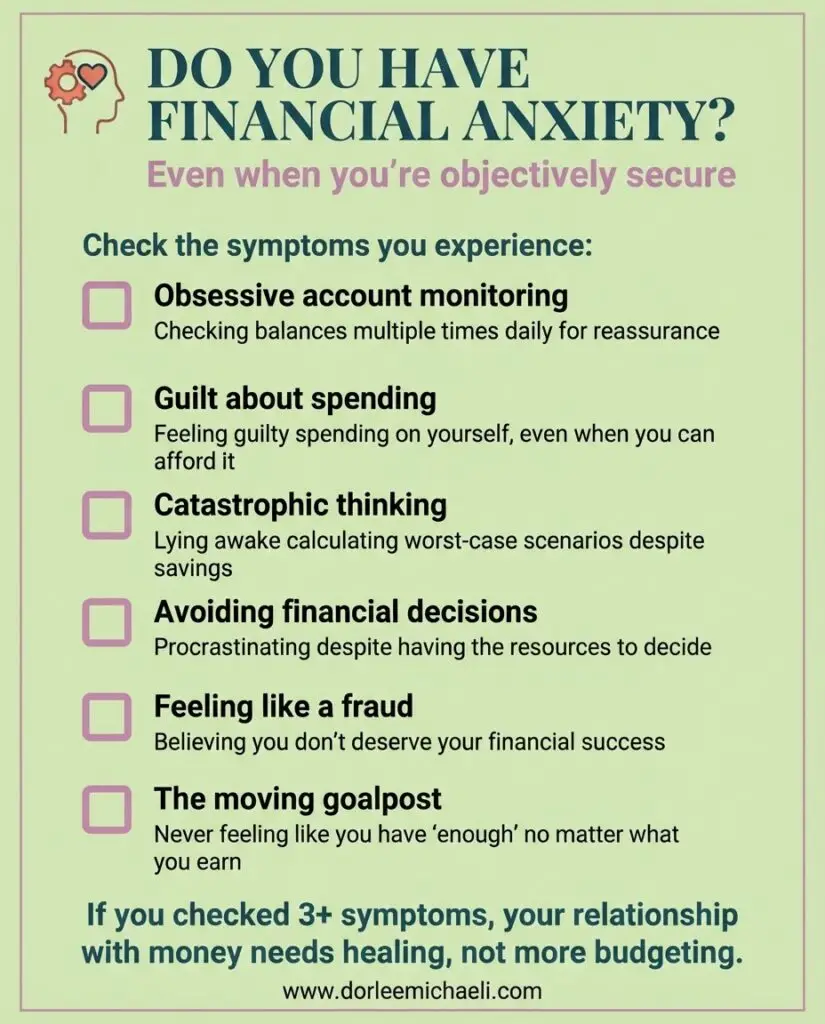
What does financial anxiety look like in high-achieving professionals? Here are the most common financial anxiety symptoms I see:
Obsessive monitoring:
- Checking investment accounts multiple times a day
- Refreshing your bank balance looking for reassurance that never comes
- Constantly calculating your net worth or runway
Guilt and restriction:
- Feeling guilty spending money on yourself, even though you can afford it
- Downplaying your income in social situations
- Restricting spending to feel in control, even when restriction isn’t necessary
Catastrophic thinking:
- Lying awake calculating survival scenarios despite having substantial savings
- Feeling like you’re one mistake away from losing everything
- Believing your financial security could disappear at any moment
Avoidance:
- Not opening investment statements because the anxiety is too much
- Procrastinating on financial decisions despite having the resources to make them
- Avoiding money conversations with your partner
Money anxiety in high achievers:
- Feeling like a fraud about your financial success
- Believing you don’t deserve what you’ve earned
- Waiting for someone to discover you’re “not really” financially successful
The moving goalpost:
- Achieving every financial milestone you set but immediately moving the target
- Never feeling like you have “enough” no matter how much you accumulate
- Tying your self-worth to your net worth
If you recognized yourself in three or more of these financial anxiety symptoms, you’re not broken; you’re experiencing a predictable response to early learning about money and safety. Here’s what causes financial anxiety.
What Causes Financial Anxiety: It’s Not About Money; It’s About What Money Means
What causes financial anxiety? It doesn’t start with your current bank balance. It starts with what you learned about money in childhood.
Maybe you grew up with scarcity, and your nervous system learned that money always slips away, no matter how hard you try to hold onto it.
Maybe you grew up with plenty, but learned that financial success came with impossible expectations, conditional love, or constant pressure to perform.
Maybe you grew up in a family where money was never discussed, so you absorbed the message that money is shameful, dangerous, or something to hide.
These early experiences get encoded in your nervous system, not your conscious memory. Your body learned to stay alert around money. Your brain learned to associate money with danger, shame, or instability.
Here’s the problem: Your nervous system formed these patterns when you were young, and it doesn’t automatically update when your circumstances change.
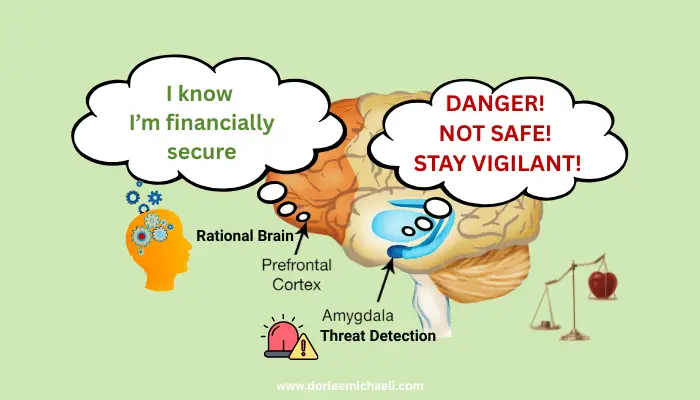
Neuroscience research shows that implicit memories, the kind formed in childhood before your explicit memory system fully developed, are stored in the amygdala and other subcortical structures.
These memories drive emotional responses without conscious awareness. According to Dr. Bessel van der Kolk, author of The Body Keeps the Score, “The body keeps the score” of early experiences, particularly around survival themes like safety and resources.
Your thinking brain knows you’re financially secure. Your survival brain is still operating on the programming it learned decades ago.
That’s why:
- More money doesn’t fix the anxiety (your nervous system adjusts to whatever you earn)
- Logic doesn’t work (you can’t think your way out of a feeling problem)
- Budgeting apps don’t help (this isn’t about managing money better)
- Financial advice doesn’t resolve it (your advisor can’t rewire your nervous system)
Financial anxiety is a nervous system problem, not a money management problem.
Financial Anxiety Treatment: How to Address It at Its Root
So if financial anxiety lives in your nervous system and not in your spreadsheets or bank statements, what kind of financial anxiety treatment actually helps?
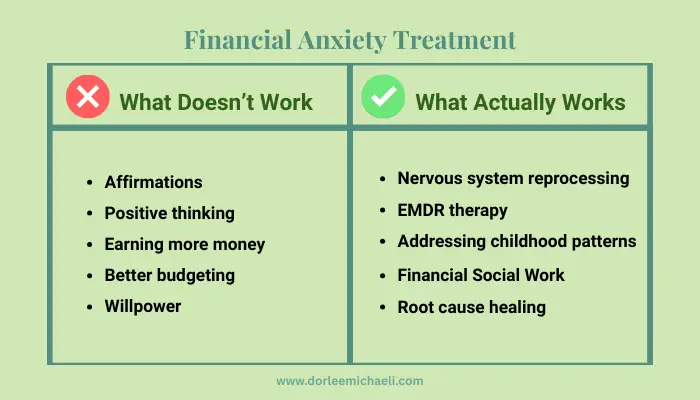
What doesn’t work:
- Affirmations and positive thinking (your amygdala doesn’t respond to logic)
- Earning more money (the anxiety scales with your income)
- Willpower or ignoring it (nervous system patterns don’t resolve on their own)
What does work:
Nervous system-based therapies like EMDR (Eye Movement Desensitization and Reprocessing) that help your brain reprocess the early experiences that created the anxiety in the first place.
EMDR is recognized by the American Psychiatric Association, the World Health Organization, and the Department of Veterans Affairs as an evidence-based treatment for trauma and anxiety disorders.
Research shows that EMDR helps the brain reprocess distressing memories and beliefs, allowing the nervous system to update its threat responses. Learn more about how EMDR therapy can help you heal financial anxiety at the nervous system level.
Effective financial anxiety treatment doesn’t just help you understand your money anxiety intellectually. It helps your nervous system update its programming, so your body can finally feel as secure as your bank account says you are.
This isn’t about learning to “manage” your anxiety better. It’s about resolving it at its root.
You’re Not Alone, And It’s Not Your Fault
Financial anxiety is particularly common among:
- High-achieving professionals who tie their self-worth to their net worth
- Entrepreneurs and founders who built wealth quickly and don’t trust it’s real
- People who grew up with financial instability and can’t believe their current security will last
- Inheritors who feel shame or imposter syndrome about wealth they didn’t earn
- Finance professionals who manage money for others but feel anxious about their own
- Anyone who experienced childhood trauma around money, poverty, or financial instability
Research shows that money beliefs formed in childhood persist into adulthood and significantly influence financial behaviors, even among high-income earners with objective financial security.
If you’re reading this and thinking “That’s me;” you’re not broken. Your nervous system is doing exactly what it was trained to do: keep you alert to financial danger.
The problem is, it’s operating on outdated information. And that’s fixable.
Frequently Asked Questions about Financial Anxiety
Financial anxiety is persistent worry and stress about money that’s disproportionate to your actual financial situation. Unlike financial stress (which happens when you don’t have enough money to cover needs), financial anxiety occurs even when you’re objectively financially stable. It’s a psychological and nervous system issue, not a money management problem.
Financial stress is situational. It matches your actual circumstances and resolves when you earn/save more. Financial anxiety is psychological. It persists regardless of your bank balance and often gets worse as you earn more. The key difference: stress is proportionate to reality; anxiety is disproportionate and lives in your nervous system, not your spreadsheets.
Financial anxiety is caused by childhood experiences and messages about money that got encoded in your nervous system before age 7. Your brain learned to associate money with danger, shame, or instability based on what you saw, heard, and experienced growing up. These patterns stored in your amygdala (threat detection system) continue triggering anxiety responses even when your adult circumstances are secure.
Yes, but not traditional talk therapy or financial counseling. Financial anxiety requires nervous system-based approaches like EMDR (Eye Movement Desensitization and Reprocessing) therapy that help your brain reprocess the childhood experiences that created the anxiety.
Financial Social Work addresses the intersection of money psychology and emotional wellbeing. Budgeting, affirmations, and logic-based approaches don’t work because they target your thinking brain, not the survival brain where the anxiety lives.
If your worry about money is proportionate to your situation (you have legitimate financial concerns), that’s responsible caution. You have financial anxiety if: your anxiety persists despite having savings/stable income, you experience physical symptoms (chest tightness, sleep disruption) around money decisions, you avoid financial decisions despite having resources, you feel guilty spending on yourself even when you can afford it, or you obsessively check accounts for reassurance that never comes. Financial anxiety feels disproportionate to your actual circumstances.
Yes, they often coexist and stem from the same root: childhood experiences that taught you your worth is conditional. Financial imposter syndrome is a specific pattern where success feels fraudulent and you believe you don’t deserve your financial achievements. Both are nervous system issues rooted in early experiences, and both can be addressed with EMDR therapy and Financial Social Work.
No. Financial anxiety scales with your income; you’ll just worry about bigger numbers. People earning $200K+ experience financial anxiety at similar rates to those earning far less. This happens because the anxiety lives in your nervous system, not your bank account. Your amygdala learned “money = danger” in childhood and continues that pattern regardless of how much you earn. You need nervous system healing, not more income.
Financial anxiety shows up in four layers: Physical (chest tightness, sleep disruption, stomach knots), Cognitive(catastrophic thinking, obsessive calculations, “I’m one mistake away”), Emotional (guilt about spending, shame about wanting, feeling like a fraud), and Behavioral (obsessive account monitoring, avoiding financial decisions, undercharging for work). If you experience symptoms across multiple layers despite being financially stable, you’re likely experiencing financial anxiety.
Healing timeline varies for each person based on trauma history, life circumstances, and other factors. EMDR therapy works at the nervous system level to reprocess childhood experiences, which typically happens over months rather than weeks.
Unlike traditional talk therapy, EMDR creates lasting change by updating implicit memory patterns. There’s no “right” pace for healing; some people progress quickly, others need more time. The important thing is that nervous system healing is possible.
Yes. Financial anxiety isn’t only caused by growing up poor. It can also develop from: growing up wealthy but learning that money came with impossible expectations or conditional love, parents who had money but were visibly anxious about it (you absorbed their nervous system response), learning that discussing money was shameful or taboo, being praised for self-denial or sacrifice, or experiencing sudden financial instability that taught you security is an illusion. It’s not about how much money your family had. It’s about what your nervous system learned money meant.
Three Paths Forward
If you recognize yourself in this guide, you have three options:
- Learn more about where financial anxiety comes from:
Read the comprehensive guide: Financial Anxiety and Childhood Money Beliefs: Why Enough Never Feels Safe
This deep dive will explore how early money messages get encoded in your nervous system, why your body doesn’t trust your bank balance, and what actually heals financial anxiety at its root.
- Understand the high-achiever angle:
Read: Financial Imposter Syndrome: Why You Don’t Trust Your Money
If you feel like a fraud about your financial success, like you don’t deserve what you’ve earned or it could disappear at any moment, this post is for you.
- Learn how to change these patterns:
Read: Why Changing Your Money Mindset Doesn’t Work
If you’re ready to address financial anxiety at its root, not with budgeting apps or positive thinking, but with nervous system work that creates lasting change, learn more about Money & Anxiety Therapy (section coming soon) or schedule a free 20-minute consultation.
REFERENCES
American Psychiatric Association. (2017). Clinical practice guideline for the treatment of PTSD. https://www.apa.org/ptsd-guideline
American Psychological Association. (2023). Stress in America: Money, inflation, and worry. https://www.apa.org/news/press/releases/stress
Klontz, B., Britt, S. L., Mentzer, J., & Klontz, T. (2011). Money beliefs and financial behaviors: Development of the Klontz Money Script Inventory. Journal of Financial Therapy, 2(1), 1-22.
LeDoux, J. E. (2015). Anxious: Using the brain to understand and treat fear and anxiety. Viking Press.
van der Kolk, B. (2014). The Body Keeps the Score: Brain, mind, and body in the healing of trauma. Viking Press.
Wolfsohn, R., & Schwartz, M. L. (2024). Financial social work: Micro, mezzo, and macro practice. Cognella Academic Publishing.
Updated: May 3, 2026




Dorlee, you certainly address the issues involved with how women do and don’t deal with financial success.
It is a topic in need of attention because even in 2026 money talk is not part of the majority of traditional social work sessions.
This means we are not providing the best client care because financial health is holistic health – which is social work in action.
I appreciate you naming that, Reeta. Financial wellbeing has always been embedded in clients’ lives, even when it wasn’t explicitly addressed in traditional clinical settings.
Integrating financial dynamics into therapeutic work feels like a natural extension of holistic care, particularly when money intersects with safety, identity, and autonomy.
The psychology of money is fascinating, Dorlee. We’re taught to want it and need it, while at the same time never to talk about it because it’s “rude”. And it’s amazing how the way we relate to money is set by our experiences growing up with it.
You’re naming something important, Erick.
Money is often framed as both essential and taboo, which can create confusion and shame early on. Those early relational messages tend to shape how safe or unsafe money feels long before we consciously evaluate it.
Financial anxiety is rarely just about numbers. It is about safety, identity, and control.
Dorlee, I appreciate how clearly you separated financial stress from financial anxiety. That distinction helps people stop blaming themselves and start understanding what is really happening.
Naming it is powerful. Once you see the pattern, you can work with it instead of fighting it.
I love it.
I appreciate how you framed that, Sandra.
Financial anxiety often touches identity and control long before it touches math. Once the pattern is named, the work becomes less about fighting symptoms and more about helping the nervous system recalibrate.
This is such an important conversation, especially for high achievers who appear financially stable on the outside yet still feel an undercurrent of anxiety around money. So often, financial anxiety hides behind professional success, promotions, and increased income. From the outside, everything looks secure. Internally, the nervous system is still bracing.
I really appreciate how this reframes financial anxiety from a personal flaw to a patterned response the body learned in order to survive. That shift alone removes so much shame. When anxiety grows alongside income, it becomes clear the issue isn’t the numbers. It’s the meaning money carries in our inner world.
Understanding that distinction opens the door to real change. Not just budgeting better, but healing the deeper story that money represents.
I really appreciate how you captured that, Madelaine.
Financial anxiety often persists alongside success, which is why so many high achievers feel confused by it. When we understand it as a patterned survival response rather than a flaw, the shame softens, and real work becomes possible.
This piece captures something I see often in clinical work the way the nervous system can remain organized around earlier experiences of scarcity or instability long after circumstances have changed. Financial security and emotional security don’t always arrive at the same time. Important conversation to keep having.
Thanks so much, Heather, for sharing this perspective from your clinical work. It’s such an important reminder that the nervous system updates more slowly than circumstances do, which can make that gap between financial and emotional security confusing for many people.
Thanks for a super informative article. I really appreciate the distinctions between financial anxiety and financial stress. “Financial anxiety starts with your current bank balance. It starts with what you learned about money in childhood.” Breathe
I’m so glad that stood out to you, Sandra. When people recognize that financial anxiety is often rooted in early learning rather than just current circumstances, it can bring a lot of clarity and self-compassion.
The high-earner vulnerability is the part most people don’t expect. The assumption is that financial anxiety scales down as income scales up. It doesn’t. Because the anxiety was never about the number. It was about what the number was supposed to mean, and when it doesn’t deliver the feeling of security it promised, the gap becomes more confusing, not less.
Lenny, I really appreciate how you articulated this.
That gap between what the number promises and what it actually delivers is often where the confusion deepens, not resolves.
Especially for high earners, where things “should” feel different.