

TL;DR: Overthinking is one of the most recognizable expressions of high-functioning anxiety, and one of the most exhausting to live with. It is not indecision, and it is not a lack of intelligence. It usually comes from a nervous system that learned, early on, to treat uncertainty as danger, and willpower alone cannot break that pattern.
When Thinking Becomes a Loop You Can’t Exit
Some decisions are genuinely hard. But if you live with high-functioning anxiety, even ordinary decisions can feel weighted with consequence.
What I call overthinking anxiety is one of the ways that anxiety most reliably shows up in high-achieving women. It’s not a clinical diagnosis, but a recognizable pattern worth naming directly.
It is also one of the clearest bridges to imposter syndrome, where the same loop that second-guesses your choices starts second-guessing your worth.
Which email to send first. Whether to speak up in the meeting. Whether to take the job, the trip, the opportunity, the next step.
From the outside, this can look like thoughtfulness. Care. Being thorough.
Inside, it feels different. It feels like trying to think your way into certainty before you are willing to move. And because certainty never arrives, the thinking keeps going.
That is the trap. Overthinking promises relief, but it usually delivers more doubt.

Is This Really Anxiety, Or Am I Just a Worrier?
It’s a fair question that is worth addressing before going further.
Overthinking anxiety is not a personality flaw. It is not that you are indecisive, weak, or neurotic.
And it is not that you think too much because you care too much, though that framing is common and sounds generous.
Overthinking that is driven by anxiety is different from careful deliberation. Careful deliberation ends. It gathers information, weighs it, and arrives somewhere.
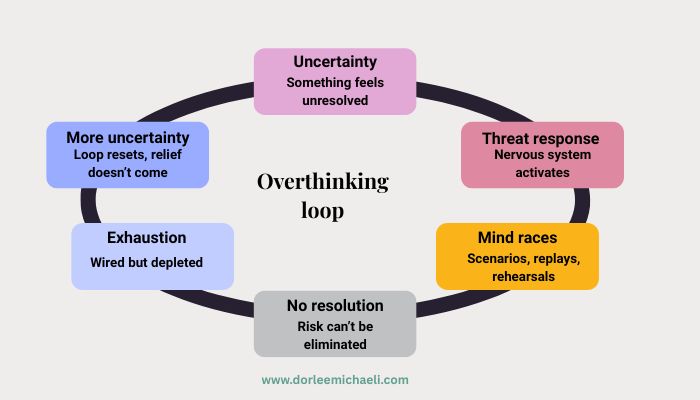
Overthinking anxiety does not end because it is not actually trying to solve a problem. It is trying to eliminate risk, and risk cannot be eliminated. Thus the loop continues.
Conscientiousness feels good. Anxiety-driven analysis is exhausting.
The distinction matters because the solution to careful deliberation is more information.
The solution to anxiety-driven overthinking is nervous system regulation, not more data.
What Is Actually Driving Overthinking Anxiety
Overthinking anxiety is not a thinking problem. It is a nervous system problem that shows up in your thinking.
When your nervous system perceives threat, it activates a survival response. For many high-achieving women, that threat is not physical danger. It is the possibility of getting it wrong, of being seen as incompetent, of making a mistake that cannot be undone.
The brain responds to that perceived threat the same way it would respond to any danger: it tries to solve its way out. It runs scenarios. It looks for the exit. It rehearses outcomes. This is the overthinking loop. It is not irrational. It is a nervous system doing exactly what it was trained to do.
That training usually happened early. Research suggests that early environments characterized by unpredictability or limited control are associated with heightened anxiety sensitivity in adulthood (Chorpita and Barlow, 1998).
When the nervous system learns that uncertainty is dangerous, it responds with repetitive negative thinking, a pattern researchers describe as transdiagnostic and driven by threat sensitivity rather than rational deliberation (Ehring and Watkins, 2008).
In adulthood, that pattern shows up as a brain that will not stop.
When the nervous system learns that uncertainty is dangerous, it tries to resolve uncertainty before acting. In adulthood, that pattern shows up as a brain that will not stop.
What It Looks Like in Real Life
Overthinking anxiety rarely looks like someone frozen at a crossroads. More often, it looks like this:
- You are lying awake at 1 a.m. running through a conversation from three days ago, editing what you should have said.
- You are drafting an email for the fourth time, not because the earlier versions were wrong, but because none of them felt safe enough to send.
- You are in a meeting, listening to someone else make the point you were about to make, and instead of speaking you spend the next ten minutes analyzing why you did not.
- You finish the day exhausted, not from what you did, but from everything you thought about doing.
This is the texture of overthinking anxiety in a professional life. It is not dramatic. It is cumulative. And it tends to be invisible to everyone except the person living it.
The Midnight Version
There is a specific version of this that happens at night, and it deserves its own paragraph.
During the day, forward motion keeps the loop at bay. There are tasks, meetings, obligations. The thinking is still happening underneath, but there is enough noise to muffle it.
At night, the noise stops. The to-do list is done. The calendar is clear. And the loop, which has been running quietly all day, becomes audible.
This is why so many women with overthinking anxiety describe their worst moments happening between 11 p.m. and 2 a.m.
It is not a new problem appearing at bedtime. It is the same problem that was there all day, finally surfacing in the silence.
Why Can’t I Just Make Myself Stop?
If you have ever asked yourself why you can’t stop overthinking, the answer is not a lack of willpower.
The most common advice for overthinking is some version of “just stop.” Set a timer. Make a decision and commit. Stop ruminating.
This advice is not wrong exactly. It is just aimed at the wrong level.
Willpower operates in the prefrontal cortex, the part of the brain responsible for reasoning and executive function. Overthinking anxiety is driven by the limbic system, the part of the brain responsible for threat detection and survival.
These two systems do not have equal authority. When the limbic system is activated, the prefrontal cortex loses influence.
This is why you can know, intellectually, that the email is fine, and still not be able to send it. Both the feelings of knowing and anxiety are real but the anxiety is louder.
Strategies that work with the nervous system rather than against it tend to be more effective.
Nolen-Hoeksema’s research on rumination found that distraction and behavioral activation were more effective than analytical attempts to resolve the loop (Nolen-Hoeksema, Wisco, and Lyubomirsky, 2008). The brain needs a pattern interrupt, not more analysis.
So What Actually Works
Somatic interrupts: use the body to break the loop. Because the loop is driven by the nervous system, physical interventions can break it more effectively than cognitive ones.
Slow exhales activate the parasympathetic nervous system. Cold water on the face or wrists can interrupt a threat response.
Even a few minutes of deliberate physical movement can shift the nervous system out of the loop.
These are not cures. They are circuit breakers that create enough space to think.
Structured decision windows: give the loop a container. Rather than trying to stop the loop entirely, containing it can reduce its grip. Choose a defined window for deliberation.
For example, thinking it through until 10am and then deciding, or giving yourself one focused hour to weigh the options and committing to close it after.
Writing the endpoint down makes it more binding. The loop does not disappear, but it has a limit.
Externalizing the thinking: move it out of your head. Writing out the loop rather than running it internally can interrupt the cycle.
Research on expressive writing suggests that translating rumination into language reduces its emotional intensity (Pennebaker and Smyth, 2016).
The thought does not change, but its charge does.
Reprocessing the root: address what is driving the loop. These strategies work at the surface.
EMDR therapy works at a different level, targeting the underlying experiences that trained the nervous system to treat uncertainty as danger.
When Overthinking Is a Signal Worth Listening To
Not every loop is noise; some of it is pointing at something real.
These strategies are worth having. And before reaching for them, one question is worth asking.
Sometimes the thing you are circling is real, a decision that genuinely matters, a situation that warrants careful thought, a relationship or role that is not working and that you have been avoiding naming directly.
Overthinking anxiety does not mean your concerns are unfounded. It means the nervous system has amplified them past the point of usefulness.
Part of the work is learning to distinguish between the signal and the amplification. What is the actual concern underneath the loop?
Once that is named, the question becomes whether the loop is helping you address it, or helping you avoid it.
Usually, it is avoidance. The loop feels like action. It is not.
Could EMDR Help With This?
EMDR is not typically associated with overthinking. It is more commonly associated with trauma, and that association is accurate.
But overthinking anxiety, particularly the kind that is persistent, exhausting, and resistant to cognitive strategies, often has roots in the same place that trauma does.
The nervous system learned something early: that uncertainty is dangerous, that mistakes have real costs, that you need to be prepared for every outcome before you are safe to move.
EMDR works by helping the brain reprocess the experiences where that learning happened, not by talking about them or analyzing them, but by updating the emotional charge attached to them so the automatic threat response loses its intensity.
When that happens, the loop loses its fuel. Deliberation becomes possible again. Decisions become easier to make and easier to release.
Shapiro’s foundational research on EMDR supports this mechanism: when the memories that established the threat response are reprocessed, the automatic activation of that response decreases (Shapiro, 2001).
You Are Not the Problem
If you have spent years trying to think your way out of overthinking, this is worth sitting with.
The loop is not a character flaw. It is not evidence that you are too anxious, too sensitive, or too much.
It is a nervous system pattern that developed for a reason, and one that can change.
The women who come to therapy for overthinking anxiety are almost always highly capable. They have managed the loop through discipline and effort for years.
What they have not been able to do is quiet it, because discipline and effort are prefrontal cortex strategies, and the loop does not live there.
You do not need to think harder. You need your nervous system to feel safer.
That is what therapy is for.
Ready to Stop Running the Loop?
If this resonates, you are probably not someone who needs to be convinced that the problem is real. You already know.
What you may not have tried yet is working at the level where the loop actually lives.
I work with high-achieving professionals in New York, New Jersey, and Chicago who are ready to stop managing their anxiety and start changing the pattern underneath it.
EMDR therapy and EMDR intensives are available weekly or in concentrated 1 to 3 day formats for faster results.
I know this pattern from the inside. I grew up in an environment where uncertainty felt genuinely unsafe, and the response I learned was to think harder, prepare more, and never let the loop fully close. I am a recovering overthinker and perfectionist. The work I do with clients is the same work I have done and continue to do on myself. That is partly why I know it is possible, and partly why I know it is not something you can think your way out of alone.
Frequently Asked Questions About Overthinking Anxiety
Overthinking anxiety is a pattern in which the mind repeatedly cycles through scenarios, decisions, or past events in an attempt to resolve uncertainty or prevent mistakes.
Unlike careful deliberation, which ends when enough information is gathered, overthinking driven by anxiety continues because its goal, eliminating risk entirely, is not achievable. It is a nervous system response, not a thinking problem.
Yes. Repetitive, uncontrollable thinking is one of the most consistent features of anxiety disorders, particularly generalized anxiety disorder.
Research identifies repetitive negative thinking as a transdiagnostic process present across anxiety and mood disorders, meaning it shows up not just in GAD but across a range of anxiety and depressive conditions (Ehring and Watkins, 2008).
If the loop is persistent, difficult to control, and causing distress, it may meet criteria for a diagnosable anxiety disorder, and a therapist can help you understand whether that applies to you.
If your thinking loop is exhausting and resistant to logic, it is worth taking seriously regardless of whether it carries a formal diagnosis.
Because the nervous system does not automatically stand down when the workday ends. Nighttime removes the distractions that keep the loop at bay during the day.
What remains is the unresolved material the mind has been circling all along, finally audible in the silence.
Yes, particularly approaches that work at the level of the nervous system rather than just cognition. EMDR therapy is effective for overthinking anxiety because it targets the underlying experiences that trained the nervous system to treat uncertainty as threat.
When those experiences are reprocessed, the automatic activation of the overthinking loop decreases.
Cognitive approaches can be useful for managing the loop in the short term, but they tend to have limited effect on the root pattern.
Careful thinking ends. It gathers information, weighs it, and arrives at a decision you can release.
Anxiety-driven overthinking does not end because it is not trying to solve a problem; it is trying to eliminate uncertainty, which is not possible.
If you find yourself returning to the same loop after a decision is already made, or if the thinking is exhausting rather than clarifying, it is likely anxiety-driven.
Not always. Careful deliberation, creative problem-solving, and sitting with a genuinely difficult decision are all forms of sustained thinking that are not anxiety-driven.
The distinguishing feature is what happens when the thinking ends: careful deliberation reaches resolution and releases.
Anxiety-driven overthinking returns to the same loop regardless of what conclusions were reached. If the loop continues after the decision is made, anxiety is likely involved.
Yes. Overthinking is one of the most consistent features of imposter syndrome.
The same nervous system pattern that drives the overthinking loop, the belief that mistakes are dangerous and that you need to be fully prepared before you are safe to act, also drives the imposter cycle of overwork, over-preparation, and self-doubt.
Many clients find that when the underlying pattern is addressed through EMDR, both the overthinking and the imposter feelings shift together.
You can read more about that pattern on the high-functioning anxiety page.
References
Chorpita, B. F., and Barlow, D. H. (1998). The development of anxiety: The role of control in the early environment. Psychological Bulletin, 124(1), 3–21.
Ehring, T., and Watkins, E. R. (2008). Repetitive negative thinking as a transdiagnostic process. International Journal of Cognitive Therapy, 1(3), 192–205.
Nolen-Hoeksema, S., Wisco, B. E., and Lyubomirsky, S. (2008). Rethinking rumination. Perspectives on Psychological Science, 3(5), 400–424.
Pennebaker, J. W., and Smyth, J. M. (2016). Opening Up by Writing It Down: How Expressive Writing Improves Health and Eases Emotional Pain (3rd ed.). Guilford Press.
Shapiro, F. (2001). Eye Movement Desensitization and Reprocessing: Basic Principles, Protocols, and Procedures (2nd ed.). Guilford Press.




This is incredibly well written, Dorlee. The distinction between careful thinking and anxiety-driven looping really stood out to me. One feels like it moves you somewhere, the other feels like running laps and ending up in the exact same place.
And I think a lot of high-achieving people will see themselves in the examples because, from the outside, it can look like thoroughness or conscientiousness, while internally it’s exhausting. The line about trying to think your way into certainty before allowing yourself to move… that one really lands.
Thanks so much, Cheryl. I think that distinction is such an important one because anxiety-driven overthinking can look incredibly responsible, conscientious, or thoughtful externally while feeling exhausting and inescapable internally.
And yes, that attempt to think your way into certainty before allowing movement is often where people get trapped, because the nervous system keeps treating uncertainty as something dangerous that must first be eliminated.