

Last updated: June 12, 2026
TL;DR: If slowing down feels more uncomfortable than staying busy, that’s not just how you’re wired. It’s a nervous system pattern, one that developed for a reason and has been running ever since. Here’s what’s driving the restlessness, what it’s quietly costing you, and what it would feel like to actually put it down.
If always busy anxiety sounds familiar, that low hum that only quiets when you’re productive; this piece is for you.
The Cost of Never Slowing Down
It’s Sunday afternoon. You have nowhere to be, nothing urgent on the calendar, and a few hours that are genuinely yours. And yet you can’t settle.
You scroll through your phone, half-read an article, think about the email you didn’t send Friday, mentally draft a to-do list for the week. You try to sit still and something in you resists. Not dramatically. Just a low, persistent hum that says: you should be doing something.
You probably call this being driven. Maybe you call it having high standards, or just being someone who cares. And in many ways, that’s true.
But there’s another possibility worth sitting with: that the inability to slow down isn’t ambition. It’s something your nervous system learned a long time ago, and it’s been running the show ever since.
This isn’t about productivity hacks or learning to meditate. It’s about understanding what’s actually happening when rest feels impossible, and why it costs more than you think.
The Hum You’ve Learned to Ignore
Most high-achieving women don’t describe themselves as anxious. Anxious feels like panic attacks, like paralysis, like something that stops you in your tracks.
What they describe instead sounds more like this:
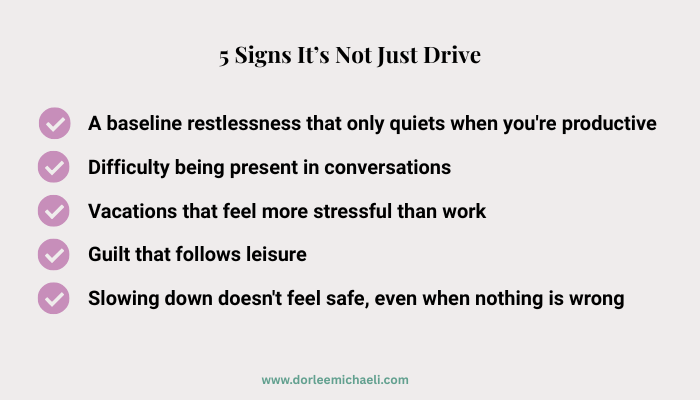
- A baseline restlessness that only quiets when they’re productive
- Difficulty being present in conversations because part of their mind is always elsewhere
- Vacations that feel more stressful than work, at least for the first few days
- A subtle guilt that follows leisure, as if enjoyment has to be earned
- The sense that slowing down isn’t safe, even when nothing is actually wrong
That last one is the tell. Because safety isn’t a logical calculation. It’s a felt sense. And for many driven women, the nervous system has learned, over years, that movement equals safety.
Doing something means you’re on top of it. Staying busy means nothing can catch you off guard.
This isn’t a character flaw. It’s an adaptation. The question is whether it’s still serving you.
The hum isn’t ambition. It’s vigilance. And vigilance is exhausting to sustain.
I recognize this pattern too. During a period when a family member’s health was a real source of worry, I noticed how much easier it was to stay busy than to sit with that fear. Productivity became a way of not feeling something I didn’t want to feel. It wasn’t until later that I could see what the busyness had actually been doing.
That’s not unusual. It’s one of the most common things this pattern protects against.
What’s Actually Happening Underneath
Here’s the plain version of what’s happening physiologically: your nervous system doesn’t distinguish very well between real threats and perceived ones.
When you were younger, maybe in an environment where performance mattered enormously, where things felt unpredictable, or where love felt conditional on achievement, your brain learned to stay alert.
Hypervigilance became the default setting.
Now you’re an adult with a career you’ve built, a life you’ve managed, and real evidence that you’re capable.
But the nervous system didn’t get the update. It’s still scanning. Still preparing. Still treating a quiet Sunday afternoon like a situation that requires monitoring.
What many high-achievers feel intuitively is consistent with what we understand about chronic stress: the body wasn’t designed to stay in a state of readiness indefinitely (McEwen, 1998). Over time, that sustained activation has real costs.
And once that pattern is set, it becomes very hard to interrupt on your own.
The Productivity Loop That Keeps You Stuck
There’s a reason this pattern is so hard to break. It’s self-reinforcing.
When you feel that restless hum, you do something productive. The doing quiets the hum, temporarily. So your brain learns: productivity equals relief.
The next time the hum shows up, the pull toward doing is even stronger. And over time, the bar for what counts as “enough” keeps rising, because the nervous system adapts to each new level of output and starts treating it as the new baseline.
This is why willpower doesn’t work here. You can’t think your way out of a pattern that lives below conscious thought.
The loop isn’t a habit in the ordinary sense. It’s a regulatory strategy, one your nervous system developed because at some point, it worked.
Trying to slow down without understanding what the busyness is protecting you from is like trying to remove a smoke alarm while the kitchen is still on fire.

The question isn’t how to do less. It’s what the doing has been standing in for.
The Things You Stop Noticing
The costs of never slowing down are easy to overlook because they accumulate slowly, and because driven women are good at compensating. You push through tired.
You show up anyway. You tell yourself you’ll rest when things calm down, not noticing that things never quite calm down, because you’re the one keeping them moving.
- Pleasure becomes muted. You do something you used to love and feel almost nothing, or a vague guilt that you should be doing something more useful. Joy requires presence, and presence requires a nervous system that’s actually off-duty.
- Sleep stops restoring. You get the hours but wake up already tired, because your body never fully downshifted.
- Relationships get the leftovers. The people closest to you see the version of you that’s already been depleted. You’re physically there but somewhere else.
- You lose access to yourself. A subtle flattening, a loss of spontaneity, a sense that you’re managing your life rather than living it. Not depression exactly. More like a dimming.
- Small decisions start to feel hard. What to eat, what to do with a free afternoon, what you actually want. When your nervous system is running at capacity, bandwidth for low-stakes choices disappears. You stop knowing what you want because you’ve stopped having the space to notice.
The nervous system doesn’t wait for a convenient time to give out. It quietly accumulates the debt.
Drive and Anxiety Aren’t Always Different Things
Here’s the question worth sitting with: what if the drive and the anxiety aren’t two separate things? What if the relentless forward motion isn’t just who you are, but also a strategy your nervous system developed to keep you safe?
That’s not a diminishment of your ambition or your work ethic. You’ve built real things. You’ve earned what you have. None of that disappears in this reframe.
But there’s a difference between moving toward something and running from stillness. And one of the quieter signs that it’s the latter is that slowing down doesn’t feel like relief. It feels like danger.
What it feels like to move toward something, rather than away from stillness, is subtler than most people expect. It’s not that you stop working hard or stop caring.
It’s that the doing starts to feel chosen rather than compulsory. You finish a project and feel satisfied rather than immediately scanning for the next thing.
You take a Sunday afternoon and actually inhabit it. The hum quiets not because you’ve filled it with activity, but because it doesn’t need to run anymore.
The doing doesn’t stop. It just stops feeling like the only thing standing between you and something going wrong.
If rest feels harder than work, that’s worth paying attention to. Not because something is wrong with you, but because it’s information.
Your nervous system is trying to tell you something, and it’s been telling you for a while. You’ve just learned to be very good at not hearing it.
You don’t have to call it anxiety. You don’t have to call it anything. But if some part of this felt familiar, if you recognized yourself in the Sunday afternoon restlessness, in the guilt that follows leisure, in the sense that slowing down isn’t safe, that recognition is the beginning of something.
The next step isn’t a productivity overhaul. It isn’t a new morning routine or a meditation app. It’s curiosity about what the hum is actually about, and what it’s been protecting you from.
If you’re ready to explore that, working with a therapist who understands high-achieving women can be a useful place to start. Not to fix what’s broken, but to understand what’s been running quietly in the background, and what becomes possible when it doesn’t have to anymore.
Frequently Asked Questions
That restlessness is usually not about the present moment; it’s a nervous system pattern. If your brain has learned that staying busy equals staying safe, stillness will feel uncomfortable even when there’s no actual threat. It’s not a character flaw. It’s a learned response.
One useful question: does slowing down feel like relief, or does it feel like danger?
Genuine drive tends to feel chosen. When the need to keep moving feels compulsory, when rest triggers guilt or unease rather than restoration, that’s worth paying attention to.
You may be off the clock but still not restored. Common signs: guilt during downtime, difficulty being present in conversations, sleep that doesn’t refresh you, and a low-level sense that you should be doing something even when nothing is urgent.
Because your body may be interpreting stillness as a loss of control. If you’ve spent years linking motion with safety and vigilance, your nervous system can treat rest as a threat rather than a reset. The discomfort is real; it’s just not accurate.
Start by noticing the pattern without judging it. The pull toward constant doing is usually protecting something, and understanding what that is matters more than trying to force yourself to rest.
Therapy with someone who works with high-achieving women can help you get underneath it.
Not at all. Meditation asks you to sit with stillness, which is exactly what feels unsafe when your nervous system is in a chronic state of readiness. It’s not a willpower problem.
Approaches that work at the level of the nervous system directly, rather than asking you to think your way to calm, tend to be more effective for this pattern.
McEwen, B. S. (1998). Stress, adaptation, and disease: Allostasis and allostatic load. Annals of the New York Academy of Sciences, 840, 33–44.


One thing I’ve noticed is that organisations often reward behaviours without understanding the function those behaviours are serving.
The person who is always available, always productive, always moving may be viewed as highly engaged.
What’s less visible is whether the behaviour is being driven by aspiration, adaptation, or a need for relief.
Understanding the function often changes how we interpret the behaviour.
Thanks so much for sharing this important observation, Lenny.
Many workplaces evaluate the behavior without ever questioning what is driving it. Constant productivity, availability, and responsiveness are often rewarded because they look like engagement and commitment.
What is less visible is whether the behavior is coming from genuine choice or from a need to reduce anxiety, avoid criticism, or feel secure.
I love how you framed this. Understanding the function changes the conversation entirely.
This one hit close to home. The distinction between ambition and vigilance is such an important one. I think a lot of high-achieving people will recognize that “hum” you describe…the feeling that rest needs to be earned or that doing is the only way to feel okay.
What I appreciate most is that you don’t frame this as a productivity problem. You invite readers to get curious about what the busyness might be protecting them from. That’s a powerful shift. Definitely worth a read for anyone who struggles to slow down, even when they finally have the chance.
Thanks so much for sharing, Cheryl.
I think that distinction is often where the conversation changes. When people see busyness purely as a productivity issue, the focus tends to be on better habits, more discipline, or improved time management.
Curiosity opens a different door. Instead of asking, “How do I stop doing this?” it invites the question, “What is this helping me avoid, manage, or feel?”