

TL;DR: Imposter syndrome isn’t a confidence problem; it’s an authority gap. High-performing women often have all the competence they need but lack the felt sense of safety to use it. This post closes a 10-part series on why capable women doubt their worth, and how EMDR therapy helps restore the authority that was always already there.
This is the final post in my 10-part Imposter Syndrome Series for quiet, high-achieving professionals.
Over the past several months, we’ve explored the hidden patterns that keep capable women doubting their worth:
- Part 1: Why Smart Women Still Feel Like Frauds – Understanding the imposter phenomenon
- Part 2: The Perfectionist’s Dilemma – When success never feels satisfying
- Part 3: The Soloist Pattern – Why asking for help feels impossible
- Part 4: The People-Pleaser Pattern – When approval-seeking fuels self-doubt
- Part 5: The Expert Trap – Why “never knowing enough” keeps you stuck
- Part 6: The Natural Genius – When effort feels like failure
- Part 7: The Superwoman Pattern – Why capable women feel they can never rest
- Part 8: The Visibility Double Bind – When being seen feels unsafe
- Part 9: Authority Gap Women – When you’re trusted with responsibility but not authority
Today, we bring it all together: Why imposter syndrome isn’t really about confidence at all. It’s about the authority gap.
You’ve read about the six imposter syndrome patterns. Maybe you recognized yourself in one, or all six, depending on the context.
The Perfectionist who can’t ship until it’s flawless. The Expert who researches endlessly before speaking up. The Natural Genius who feels like a fraud when something requires effort. The Soloist who refuses help. The Superwoman juggling too many roles to prove her worth. The People Pleaser who can’t state a preference without checking everyone else’s opinion first.
Different patterns. Different behaviors. But here’s what ties them all together:
High-performers rarely lack competence. They lack safety using their authority.
THE DIFFERENCE BETWEEN CONFIDENCE AND AUTHORITY
Most advice about imposter syndrome focuses on confidence: “Just believe in yourself!” “Fake it till you make it!” “Remember your accomplishments!”
But confidence isn’t the problem.
Confidence = believing you CAN do something
Authority = trusting you have the RIGHT to do something
You’re competent. You’ve proven that repeatedly. You have the skills, the experience, the track record.
What you don’t have is the internal sense that it’s safe to claim your expertise. To speak up without over-explaining. To set a boundary without justifying it. To share your work before it’s perfect. To disagree with someone more senior. To charge what you’re worth.
This is the authority gap, the space between what you’re capable of and what you feel safe claiming.
Journalist Mary Ann Sieghart coined the term “authority gap” to describe how women’s expertise is systematically undervalued in her book *The Authority Gap: Why Women Are Still Taken Less Seriously Than Men*.
While Sieghart’s work examines the external, systemic nature of this gap, I’m exploring its internal psychological dimension: how early experiences teach your nervous system that claiming authority is dangerous, even when you’re objectively competent.
And no amount of confidence-building will close that gap, because the issue isn’t self-belief. It’s safety.
A NOTE ON TERMINOLOGY
In everyday conversation and popular writing, this experience is most commonly referred to as “imposter syndrome.”
In academic research, it’s typically called “imposter phenomenon.”
Throughout this article, I’ll use “imposter syndrome” since that’s the term most people know, but when you see research citations, you’ll notice they use “imposter phenomenon.”
Both terms describe the same experience: high-achieving individuals who, despite objective evidence of success, feel like frauds and fear being exposed.
SYNDROME PATTERN LOSES AUTHORITY DIFFERENTLY
Each imposter syndrome pattern is a different strategy for avoiding the vulnerability of claiming authority.
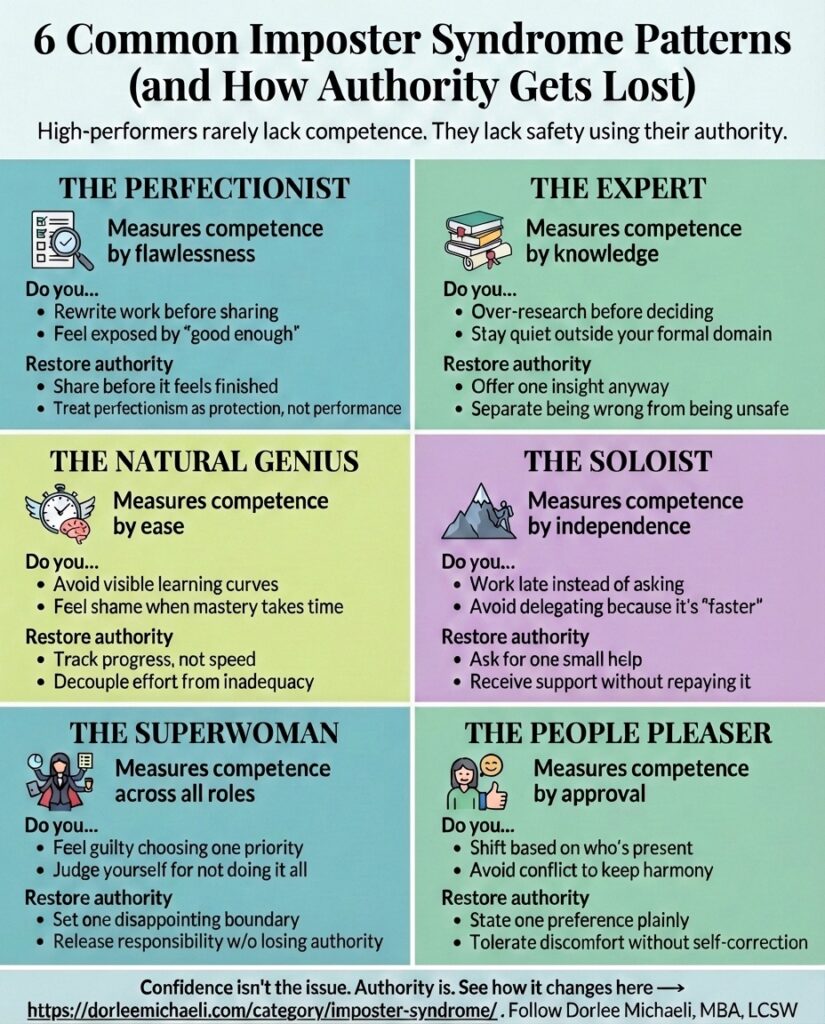
HOW EACH IMPOSTER The Perfectionist delays authority.
The pattern: “I’ll share my work when it’s flawless.”
What’s really happening: If you never finish, you never have to face judgment. Perfectionism protects you from the vulnerability of being evaluated.
The authority gap: You have expertise, but claiming it feels dangerous. so you delay indefinitely.
Authority restoration: Share before it feels finished. Let “good enough” be your standard, not “flawless.”
The Expert outsources authority.
The pattern: “Let me gather more data before I weigh in.”
What’s really happening: If you’re still researching, you’re not yet claiming a position. More credentials, more research, more preparation, all ways to delay the moment when you have to trust your own judgment.
The authority gap: You have knowledge, but trusting it feels risky – so you keep deferring to external sources.
Authority restoration: Offer one insight without over-researching. Trust what you already know.
The Natural Genius conditions authority on ease.
The pattern: “If it’s hard for me, I must not be good at this.”
What’s really happening: If competence must come naturally, then struggle equals failure. You avoid anything that requires sustained effort because it threatens your identity as “naturally talented.”
The authority gap: You have ability, but only feel safe claiming it when it comes easily.
Authority restoration: Track progress, not speed. Celebrate effort, not just ease.
The Soloist refuses authority through help.
The pattern: “I need to do this alone, or it doesn’t count.”
What’s really happening: If asking for help means you’re weak or incompetent, then you’ll exhaust yourself trying to prove you don’t need anyone.
The authority gap: You have capability, but only feel safe claiming it if you’ve done everything yourself.
Authority restoration: Ask for one small help. Let collaboration strengthen your authority, not diminish it.
The Superwoman diffuses authority across too many roles.
The pattern: “I need to excel at everything – work, parenting, fitness, hobbies, relationships.”
What’s really happening: If you’re proving your worth everywhere, you never have to face the possibility that you’re not enough in one area. Overcommitment protects you from the vulnerability of being evaluated in any single role.
The authority gap: You have competence in multiple areas, but claiming authority in ONE feels too risky – so you spread yourself impossibly thin.
Authority restoration: Set one disappointing boundary. Let yourself be “just okay” in one area while you excel in another.
The People Pleaser surrenders authority to approval.
The pattern: “What do you think I should do?”
What’s really happening: If you defer to others’ opinions, you never have to risk being wrong. Seeking consensus protects you from the vulnerability of standing alone in your judgment.
The authority gap: You have insight, but trusting it feels dangerous – so you constantly check with others first.
Authority restoration: State one preference plainly. Let your judgment stand without needing validation.
THE UNIFYING PATTERN: SAFETY, NOT SKILL
Look at those six patterns again. Notice what they have in common?
None of them are about lacking competence.
The Perfectionist has high standards because they’re skilled enough to see the gap
The Expert has deep knowledge; that’s why they keep seeking more
The Natural Genius has natural ability – that’s why struggle feels threatening
The Soloist is capable; that’s why they can do it alone
The Superwoman excels in multiple areas; that’s the problem
The People Pleaser has good judgment; they just don’t trust it
The issue isn’t capability. It’s that using your authority doesn’t feel safe.
WHY I UNDERSTAND THESE PATTERNS SO DEEPLY
I’ve lived this work from both sides, as someone who struggled with these patterns myself, and now as the therapist who helps others break free from them.
My own authority gap showed up as a combination of four patterns: the Perfectionist, the Expert, the Superwoman, and the People Pleaser.
As a Perfectionist, I would check and recheck my blog posts endlessly, finding yet another way to phrase something better, another angle to consider. I had to trick myself into “just starting a draft I could edit later,” otherwise I’d never publish anything.
As an Expert, I pursued psychoanalytic training not just for the knowledge, but because I wanted the more extensive supervision it provided. Even after getting my LCSW in 2019 and no longer being required to have supervision, I still pay for it. The difference now is that I seek it from a desire to improve my craft, not from fear that I’m inadequate without it.
As a People Pleaser, a younger part of me was terrified of disappointing or angering others. I’d prioritize everyone else’s needs and wants ahead of my own, struggle to state what I actually wanted, and feel guilty when I couldn’t make everyone happy.
As a Superwoman, I told myself I needed to excel at everything: be the perfect therapist, run a flawless business, maintain a spotless home, stay in peak physical shape, be fully present for my family, and never, ever show signs of struggling.
What I discovered through my own EMDR work and therapy was this: The issue wasn’t my competence. It was that my nervous system had learned early on that authority had to be earned through perfection, expertise, and constant productivity, and that claiming my own needs meant risking rejection.
Through therapy, I gained the ability to stand up for what my needs and wants are, not just thinking of others ahead of myself. Now, I still feel anxious before a podcast interview, but it’s the excited kind of nervous, not the fear-of-being-exposed kind. And I can disappoint someone or say no without it threatening my sense of safety.
That’s the work we do together.
WHY TRADITIONAL CONFIDENCE ADVICE FAILS
Now you can see why “just believe in yourself” doesn’t work.
You DO believe in yourself, intellectually. You know you’re competent. You’ve seen the evidence.
But your nervous system learned something different. It learned:
- Speaking up gets you dismissed (so delay with perfectionism)
- Claiming expertise gets you challenged (so defer to more research)
- Struggling means you’re a fraud (so only do what comes easily)
- Asking for help means you’re weak (so do everything alone)
- Focusing on one thing means neglecting others (so prove yourself everywhere)
- Disagreeing gets you rejected (so seek approval first)
These aren’t thoughts. They’re survival strategies your nervous system developed to keep you safe.
And no amount of affirmations will convince your nervous system that it’s safe to claim your authority when your early experiences taught you otherwise.
WHERE THE AUTHORITY GAP COMES FROM
Authority loss often stems from specific early experiences:
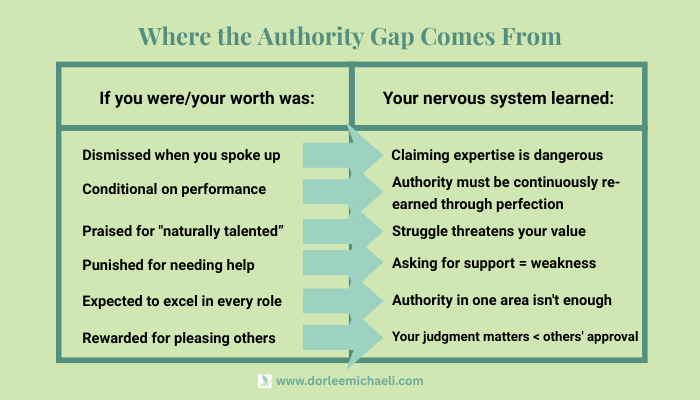
These experiences didn’t just create beliefs. They created nervous system responses that activate every time you’re in a position to claim your authority.
Your amygdala (threat detection system) scans for danger: “Is it safe to speak up? To disagree? To share my work? To set this boundary?”
And based on past experiences, it often concludes: “No. Not safe. Use the protective strategy instead.”
Research shows that when we experience trauma or adverse experiences, the nervous system becomes primed to detect threats – making it more likely that defensive responses will be activated.
The body’s fight-or-flight response activates the sympathetic nervous system, and after traumatic experiences, this system can become dysregulated, remaining hypervigilant even in safe situations.
This is why claiming authority can feel genuinely dangerous to your nervous system, even when you’re objectively safe.
HOW EMDR RESTORES AUTHORITY
EMDR therapy doesn’t teach you to override your nervous system with willpower or positive thinking.
It helps your brain reprocess the actual experiences that created the authority gap in the first place.
Here’s what that looks like:
We identify the specific moments where claiming authority became linked with danger:
- Being dismissed when you shared an idea
- Being criticized harshly for a mistake
- Being praised only when you performed perfectly
- Being shamed for needing help
- Watching a parent struggle under impossible expectations
- Learning that disagreement meant rejection
We explore the beliefs those moments created:
- “It’s not safe to be visible”
- “My worth depends on perfection”
- “Struggle means I’m a fraud”
- “Asking for help means I’m weak”
- “I must prove myself everywhere”
- “My judgment doesn’t matter”
We use EMDR to reprocess these memories so your nervous system can release the emotional charge.
Using bilateral stimulation (eye movements, taps, or sounds), your brain “digests” these experiences so they no longer trigger the same protective responses.
We build new beliefs that restore your authority:
- “It’s safe to be seen in my expertise”
- “My worth isn’t conditional on perfection”
- “Struggle is part of mastery, not evidence against it”
- “Asking for help is strategic, not weak”
- “I can excel in one area without proving myself everywhere”
- “I can trust my judgment”
EMDR’s effectiveness is well-established through extensive research.
Multiple randomized controlled trials demonstrate that EMDR helps the brain reprocess traumatic memories and adverse life experiences, reducing their emotional charge.
While researchers continue to study the specific mechanisms that make EMDR work, the treatment outcomes are clear: people process and move past their trauma more quickly than with many other therapeutic approaches, often seeing results in fewer sessions.
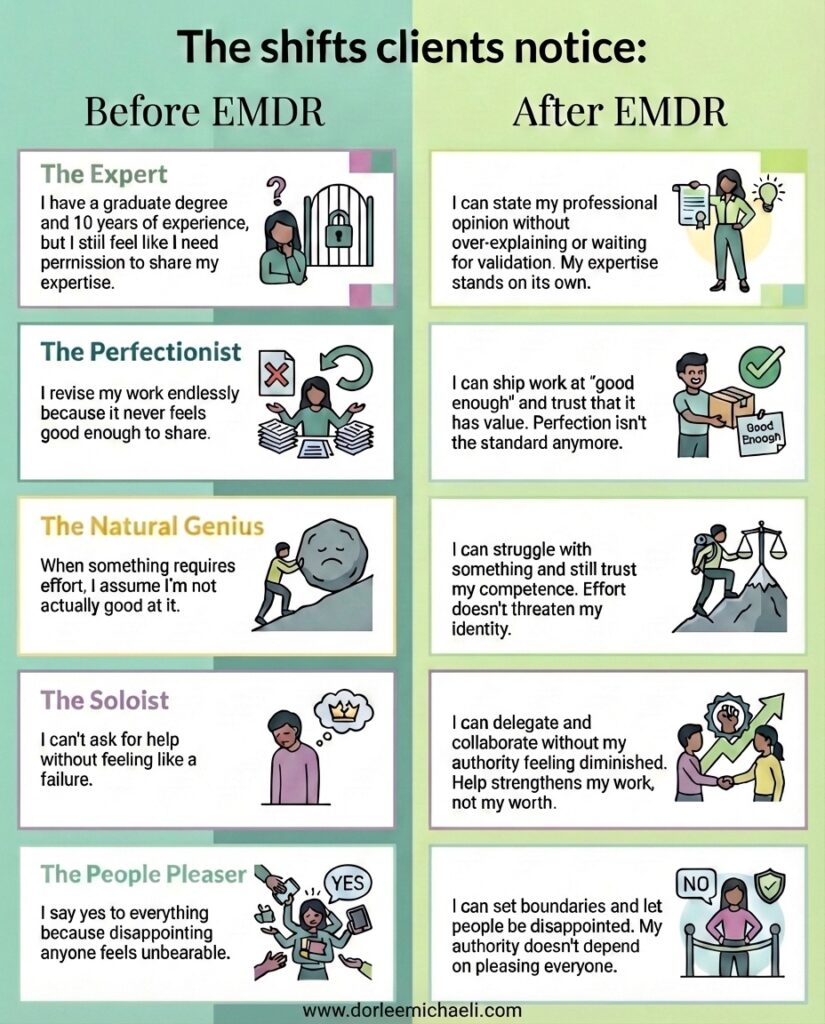
WHAT AUTHORITY RESTORATION LOOKS LIKE IN PRACTICE
Restoring authority isn’t about building confidence. It’s about removing the blocks to using the authority you already have.
Here’s what that looks like for each pattern:
The Perfectionist: Shares work before it feels finished. Lets “good enough” be the standard. Publishes the article, sends the email, launches the project, even when it’s not flawless.
The Expert: Offers one insight without over-researching. Trusts existing knowledge. Weighs in on the meeting discussion without needing three more sources first.
The Natural Genius: Tracks progress, not speed. Celebrates effort, not just ease. Stays with the challenging project instead of abandoning it when it requires sustained work.
The Soloist: Asks for one small help. Delegates one task. Lets collaboration strengthen authority instead of threatening it.
The Superwoman: Sets one disappointing boundary. Says no to one commitment. Lets herself be “just okay” in one area while excelling in another.
The People Pleaser: States one preference plainly. Makes one decision without seeking consensus first. Lets her judgment stand without needing validation.
These aren’t confidence exercises. They’re authority reclamation practices.
Each small action rewires your nervous system: “I claimed my authority. I was safe. I can do it again.”
THE GOAL: AUTHORITY THAT FEELS NATURAL, NOT FORCED
Healing the authority gap doesn’t mean you’ll suddenly become arrogant or stop caring about quality.
It means you’ll:
- Trust your expertise without needing constant external validation
- Share your work at “good enough” instead of waiting for perfect
- Stay with challenges instead of abandoning them when they require effort
- Ask for help without it threatening your competence
- Set boundaries without needing to prove yourself everywhere
- State your judgment without constantly checking with others first
- Claim your authority because it feels safe, not because you forced yourself to “be confident”
Authority isn’t something you build. It’s something you already have; you just need to remove the blocks to using it.
That’s the work we do together.
THE BIGGER PICTURE: AN ORGANIZATIONAL ISSUE
It’s important to recognize that imposter syndrome isn’t just an individual struggle; it represents a psychological health issue at work that ultimately affects organizational functioning.
When high-performers can’t safely claim their authority, organizations lose out on their full contributions: innovative ideas go unshared, leadership potential remains untapped, and talented professionals leave roles where they never felt they belonged.
Understanding imposter syndrome as a response to environmental context, rather than simply an individual deficit, allows us to address it more effectively, both through individual healing and through creating workplaces where people genuinely feel safe claiming their expertise.
This is a crucial question, and the answer is often “both.”
The organizational reality:
If you’re carrying significant responsibility without corresponding authority (can’t make final decisions, need constant approval, lack resources to do your job well), your “imposter feelings” may actually be an accurate read of a dysfunctional structure. You’re not imagining it; the gap is real.
When organizations give you accountability without autonomy, expect excellence without support, or require you to “prove yourself” endlessly before granting authority, they create conditions where even confident people experience self-doubt.
The internal pattern:
At the same time, many high-achieving women have nervous systems trained to accept these conditions as normal. You may not recognize the authority gap as a problem because you learned early that:
- You have to earn authority through perfect performance
- Your expertise isn’t inherently valuable
- Asking for what you need means you’re demanding or difficult
- If you just work harder, eventually you’ll be trusted
Why EMDR helps even when the gap is organizational:
EMDR doesn’t change your workplace structure, but it changes your relationship to it:
Before EMDR:
- You internalize the authority gap as evidence you’re not ready
- You work harder to “prove” you deserve authority (reinforcing the pattern)
- You don’t recognize you deserve better conditions
- You stay in situations that exploit your competence while undermining your confidence
After EMDR:
- You can identify when an authority gap is organizational, not personal
- You recognize which feelings are old patterns vs. valid responses to dysfunction
- You feel entitled to advocate for appropriate authority and resources
- You can make clearer decisions about whether to push for change or leave
The practical outcome:
Some clients use their newfound clarity to successfully advocate for structural changes, presenting evidence of the authority gap and negotiating for decision-making power, resources, or title changes that match their responsibilities.
Others realize the organization won’t change and use their restored confidence to pursue opportunities where their expertise will be properly recognized and resourced from the start.
The key shift:
You stop asking “What’s wrong with me that I feel this way?” and start asking “Is this environment structured to support my success, and if not, what are my options?”
EMDR helps you trust your read of the situation rather than defaulting to self-doubt. Whether you stay and advocate or leave for better conditions, you’re making the choice from confidence rather than fear.
The timeline varies based on your specific experiences, but imposter syndrome patterns typically require consistent work before you see meaningful shifts.
Many clients begin noticing changes around 12-15 sessions, feeling less anxious before presentations, speaking up more naturally in meetings, or setting boundaries without guilt. These patterns developed over years or decades, so they need adequate time to reprocess.
While single-incident situations might resolve more quickly, imposter syndrome usually involves multiple interconnected experiences that need to be addressed.
The Superwoman who learned early that her worth depended on constant achievement, for example, will need time to work through the various memories and beliefs that created that pattern.
EMDR therapy intensives offer a concentrated approach, 1-3 focused days that allow you to work through patterns more quickly than weekly sessions. Many clients choose intensives when facing an upcoming promotion, career transition, or major life change.
EMDR doesn’t “cure” imposter syndrome like antibiotics cure an infection. Instead, it helps you shift the underlying nervous system patterns so self-doubt no longer controls your decisions.
Most clients find that imposter feelings become quieter, less frequent, and easier to recognize when they do show up.
The goal isn’t eliminating all self-doubt; it’s building steady confidence that doesn’t depend on being perfect or constantly proving yourself.
When imposter thoughts arise, you’ll recognize them as old patterns rather than truth, and they’ll pass more quickly without derailing your day or decisions.
Yes. EMDR works effectively in virtual sessions using bilateral stimulation techniques adapted for online therapy: on-screen visual tracking, self-tapping, or audio tones delivered through headphones.
Research published in the Journal of EMDR Practice and Research (2021) found virtual EMDR significantly reduced PTSD symptoms with outcomes matching in-person therapy. The same effectiveness applies toimposter syndrome work.
I offer virtual EMDR across New York, New Jersey, and Illinois, with limited in-person sessions available in Chicago. Many clients actually prefer virtual sessions because they can process in the comfort and safety of their own home.
Yes. EMDR can work with present-day triggers, like freezing before a presentation, over-preparing for meetings, or feeling paralyzed when someone praises you, and trace them back to their origins.
You don’t need perfect recall of childhood for EMDR to be effective. Your nervous system remembers even when your conscious mind doesn’t.
We can start with current situations that trigger imposter feelings and let your brain naturally connect them to earlier experiences during the reprocessing.
Many of my clients can’t pinpoint one “big” event, but they know something feels stuck. That’s enough to begin.
No. This work isn’t about teaching you to slack off or lower your standards.
It’s about helping you be successful without being controlled by old insecurities.
When your authority gap closes, you work hard because you enjoy what you do and value excellence, not because you’re terrified of being exposed as a fraud.
You maintain high standards, but they come from self-respect rather than fear.
Many clients actually become more productive because they’re no longer spinning their wheels with perfectionism, people-pleasing, or endless over-preparation.
Your drive shifts from anxiety-fueled to purpose-driven. You can finally rest without guilt because you trust that your worth isn’t conditional on constant output.
Talk therapy helps you understand imposter syndrome, where it came from, why it persists, how it shows up in your life.
That insight is valuable, but understanding doesn’t always create lasting behavioral change.
EMDR helps your brain reprocess the actual experiences that created the authority gap.
It works directly with your nervous system to release the emotional charge from memories, like being dismissed when you spoke up, criticized harshly for mistakes, or learning that your worth was conditional on performance.
Instead of just knowing intellectually that you’re capable, EMDR helps your nervous system feel that you’re safe claiming your expertise.
Understanding is helpful, but reprocessing creates the deeper, lasting change that shows up in how you actually move through your day.
EMDR may be right for you if:
You recognize yourself in multiple imposter syndrome patterns
You feel exhausted by constant self-doubt despite clear evidence of your competence
You want to stop over-functioning and start trusting your expertise
Traditional approaches (positive thinking, affirmations, skills training) haven’t created lasting change
You’re open to exploring how early experiences shaped your nervous system responses
You want practical, embodied change, not just new ways of thinking about the problem
If that resonates, schedule a free consultation to explore whether this work is right for you.
We’ll discuss your goals, answer any questions, and determine together if EMDR is the best fit for where you are right now.
READY TO CLOSE YOUR AUTHORITY GAP?
If you recognized yourself in these imposter syndrome patterns , if you’re competent but don’t feel safe claiming your expertise, EMDR therapy can help you reprocess the experiences that created the authority gap.
You don’t need more confidence. You need to restore the authority you already have and learn that it’s safe to use it.
I specialize in helping high-achieving professionals in New York, New Jersey, and Chicago close the authority gap , so you can finally trust the expertise you’ve spent years building.
This concludes the 10-part Imposter Syndrome Series.
Throughout this series, we’ve explored:
- How imposter syndrome develops and why it persists
- The six core patterns (Perfectionist, Soloist, Expert, Natural Genius, Superwoman, People-Pleaser)
- The visibility double bind and authority gap
- Why traditional confidence advice fails
- How EMDR and trauma-informed therapy restore authentic authority
If you missed any posts in the series, you can find them all in the Imposter Syndrome archive.




This series has put language to something so many capable women feel but struggle to name. The way you distinguish between confidence and authority, and between skill and safety, really landed for me. I especially appreciated how gently you wove nervous system patterns into what’s often framed as a purely mindset issue. This didn’t feel like advice to fix myself; it felt like an invitation to understand myself with more compassion. Thank you for naming what so often gets internalized as a personal failing when it’s really a much bigger pattern.
Thanks so much for taking the time to share this, Cheryl. I’m really glad the distinctions between confidence and authority, and between skill and safety, resonated. My hope with this series was exactly what you named, to move the conversation out of self-fixing and toward understanding these patterns with more compassion and context. I appreciate you naming how that landed.
Wow, what a deep and rich 10-part series. Sooo much amazing information throughout, Dorlee. I am grateful to have imbibed in your thoughtful stories and detailed explanations around ‘imposter syndrome.’
I copied and pasted this section, as it struck me and really helped me to internalize what imposter syndrome looks like, in action. ==>
“What you don’t have is the internal sense that it’s safe to claim your expertise. To speak up without over-explaining. To set a boundary without justifying it. To share your work before it’s perfect. To disagree with someone more senior. To charge what you’re worth.
This is the authority gap, the space between what you’re capable of and what you feel safe claiming.”
—
Within the meaty messaging you spoke to becoming more comfortable ‘disappointing someone,’ as a result of EMDR and therapy. I loved this, because the idea of shedding discomfort when being the recipient of someone’s negativity (i.e., they express disappointment because I didn’t write a career story to their vision or their colleagues’ vision when they passed it around to 10 people for 10 opinions!), would greatly alter my anxious discomfort in awaiting feedback after delivering a project.
As well, I enjoyed the graphic illustrations demonstrating how to restore authority. Brilliant, small steps that lead to transformation.
There’s so much more I could remark on, because this is more than a blog post, it is a detailed report, action plan and guide! Your knowledge, passion and experience in the areas around this topic are life- and career-changing.
Thank you for all you do for quiet, high-achieving professionals. They are lucky to have you in their court!
Thanks so much, Jacqui, for your kind words and thoughtful engagement with this series. The authority gap is very much the conceptual throughline of the entire series, so I’m especially glad that this section helped make imposter syndrome feel more concrete and observable in day-to-day behavior.
What you highlighted about learning to tolerate disappointment is such a central nervous system shift. For many high-achieving people, safety has been historically organized around meeting expectations, managing others’ reactions, and minimizing friction. When that’s the case, even mild disappointment from others can register as threat rather than as a normal part of relational or professional life. Relearning that it’s safe to be disappointing, without over-functioning or self-erasure, opens up a very different relationship to feedback, authority, and self-trust.
The example you gave about post-project anxiety captures this perfectly. That waiting space is often where earlier patterns around managing others’ reactions get reactivated, and where restoring internal authority makes a meaningful difference over time.
I’m so lucky to have you in my court. You’re not just a supportive friend, but someone whose career expertise and resume wisdom I really admire.