
TL;DR: The visibility double bind is the internal conflict that arises when career growth requires being seen, but your nervous system registers visibility as a threat. This post explains why showing up, speaking out, and taking credit can feel physically unsafe, and how nervous system regulation helps quiet high-achievers step forward without shutting down.
Have you ever hesitated to share your ideas, not because you lacked skill, but because being visible felt uncomfortable?
Many high achievers quietly carry this tension for years without having a name for it.
Until now.
What Is the Visibility Double Bind?
The Visibility Double Bind is the internal conflict many quiet high achievers experience when success requires being seen, yet visibility activates the nervous system as a possible threat.
You want to contribute.
You want to grow.
You want to be recognized…
But your body says:
“Visibility is not safe.”
This pattern often overlaps with imposter syndrome, but it is not the same. They frequently co-occur, but the Visibility Double Bind has its own emotional signature:
A fear of being seen and evaluated, even when you’re highly capable.
Dr. Stephen Porges, the neuroscientist who developed Polyvagal Theory, explains that our autonomic nervous system constantly scans for cues of safety and danger through a process called neuroception, one that happens below our conscious awareness, before we even realize we’re reacting.
This automatic detection system is at the heart of why visibility can feel so threatening, even when logically we know we’re safe.
A PERSONAL NOTE
As someone who spent years believing that staying quiet kept me safe, I know how visibility can feel less like opportunity and more like exposure. As a recovering perfectionist, expert trap over-preparer, and former people pleaser, I had learned early that blending in felt safer than taking up space.
You are not alone in this.
Meet Maya: A High Achiever Who Felt Safer Staying Small
Maya, a thoughtful team lead in tech, was invited to present at an executive meeting, a well-earned opportunity.
Yet instead of pride, her throat tightened.
Even imagining the meeting made her chest buzz, as if her words might fail her when she needed them most.
Inside, she heard:
“Don’t stand out. Don’t say the wrong thing. Don’t take up too much space.”
Her colleagues saw brilliance.
Her nervous system saw danger.
Through therapy, Maya slowly began noticing the exact moments her body shifted into threat response. She practiced micro-visibility in lower-stakes settings and learned that being seen did not have to mean being unsafe.
Where This Pattern Often Begins
The Visibility Double Bind does not come from one single cause. Rather, a constellation of temperament, relational history, and nervous-system learning may contribute.
Many adults who struggle with visibility grew up in environments where:
- Emotional needs were inconsistently met
- Being “easy,” quiet, or self-sufficient was praised
- Mistakes were met with criticism or withdrawal
- Praise came with pressure or higher expectations
- They were pushed to perform but not invited to express
- Attention from adults felt unpredictable
It’s important to note that not everyone who experiences the visibility double bind traces it back to childhood.
For some, this pattern emerges later, through workplace dynamics, cumulative experiences of marginalization, cultural messages about who deserves to be seen, or repeated moments where visibility led to criticism or professional harm. The origins may be varied, but the nervous system’s protective response remains the same.
Over time, the body develops a protective equation:
Visibility = exposure
Staying small = safety
This is neuroception, the nervous system’s automatic detection of internal and external cues of safety or threat, a process that happens below conscious awareness, before you even realize you’re reacting.
How the Visibility Double Bind Shows Up at Work
• avoiding promotions or opportunities even when ready
• minimizing or deflecting praise
• over-preparing for presentations
• letting others take credit to avoid being in the spotlight
• withholding ideas until they feel perfectly phrased
• feeling depleted by constantly helping others yet uncomfortable when recognized
At the same time, many quiet high achievers feel frustrated when overlooked for advancement. The bind persists: “I want to be seen, but I do not want to feel exposed.”
Why the Visibility Double Bind Feels So Powerful
Polyvagal theory helps explain why awareness alone cannot override this pattern.
Visibility itself is not dangerous, but it may activate the same defensive systems that once protected you from actual threat.
To understand what’s happening in your body when you experience the visibility double bind, it helps to look at what clinician Deb Dana calls the ‘polyvagal ladder,’ a practical framework that maps our nervous system’s three key states and how we move between them.
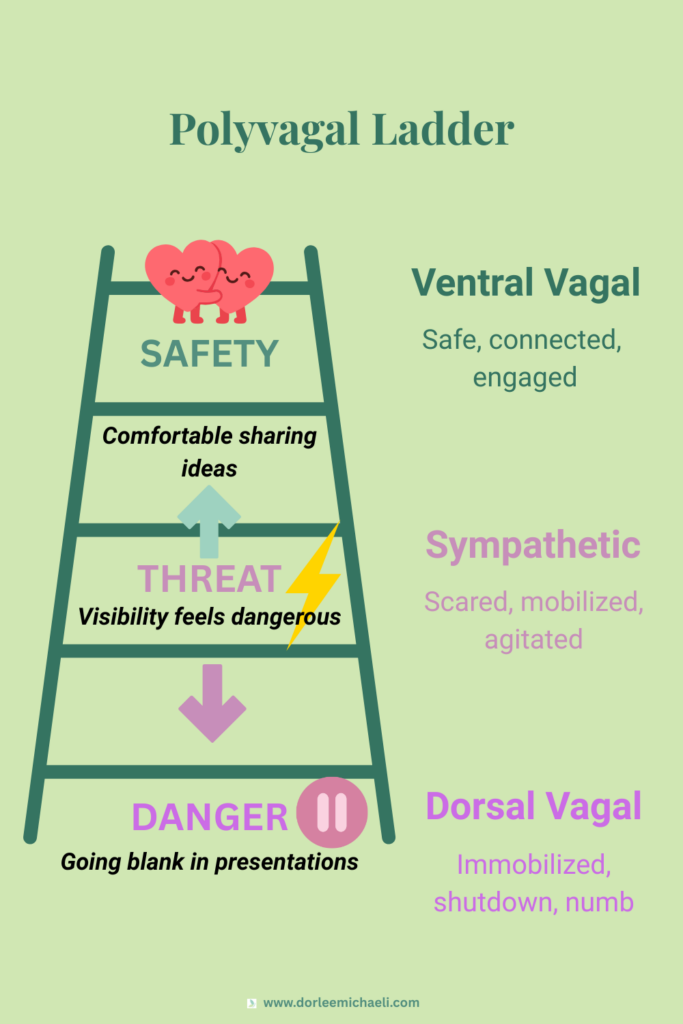
When you feel safe and connected (ventral vagal state), visibility feels manageable. You can comfortably share ideas and engage authentically.
But when your nervous system detects threat, you may drop down the ladder into mobilization (sympathetic activation) or immobilization (dorsal vagal shutdown).
Understanding which rung of the ladder you’re on helps you recognize what your body needs to feel safer.
For some, visibility triggers:
Sympathetic activation
- racing thoughts
- perfectionistic over-preparing
- hypervigilance
Dorsal vagal shutdown
- foggy thinking
- going blank
- shutting down or disconnecting/numbing out
These responses are not irrational; they are adaptive. Your nervous system is using the same protective strategies (sympathetic fight-or-flight activation or dorsal vagal shutdown) that once kept you safe in genuinely threatening situations.
This is why “just be more confident” never works.
The goal isn’t confidence.
The goal is safety.
When the body feels safer, confidence grows naturally.
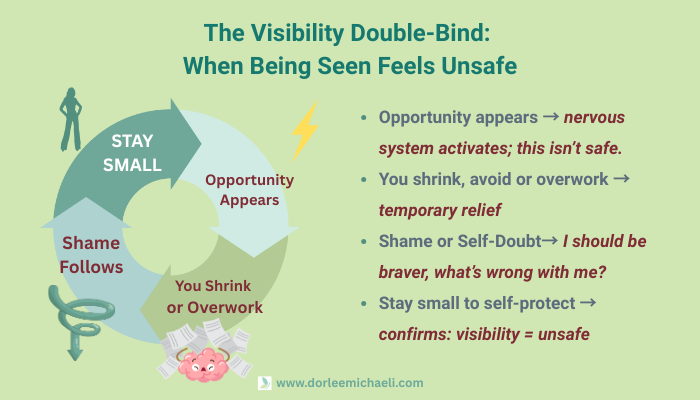
The cycle continues until safety, not pressure, guides change.
YOU DON’T HAVE TO STAY STUCK HERE
Recognizing this pattern is the first step. The next step is creating safety within your nervous system so visibility becomes a choice, not a threat.
If this resonates and you’re ready for support, I’d welcome the opportunity to talk.
How to Begin Releasing the Visibility Double Bind
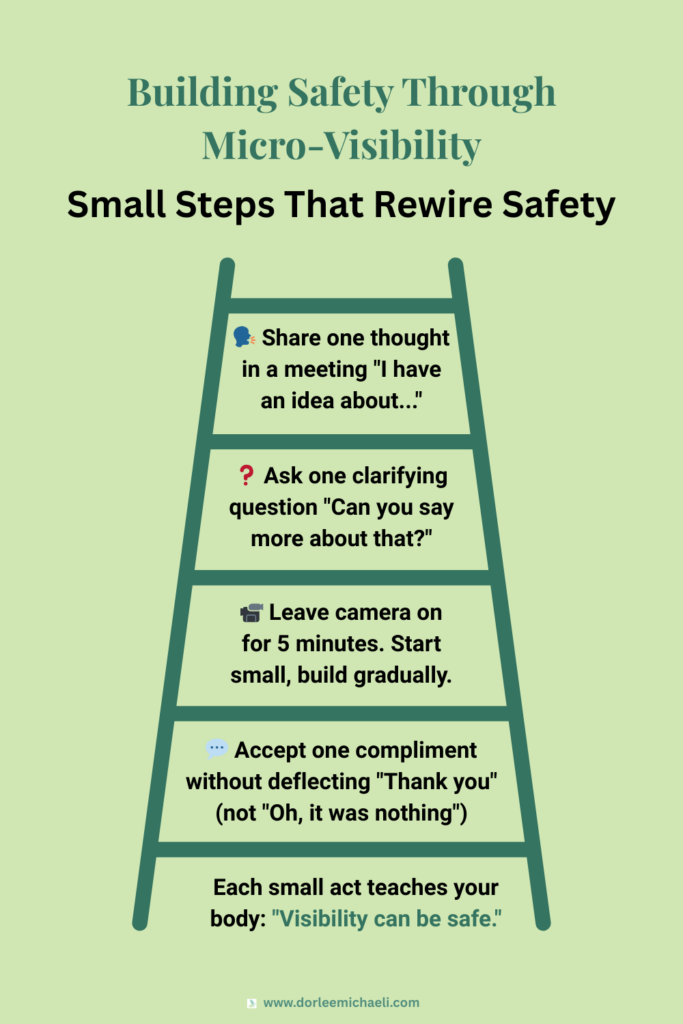
1. Start with Micro-Visibility
Large leaps can overwhelm the nervous system.
Micro-visibility gently rewrites safety:
- Share one thought in a meeting
- Ask one clarifying question
- Leave your camera on for the first five minutes
- Accept one compliment without deflecting
Each small act teaches the body:
“Visibility can be safe.”
2. Regulate Before You Reveal
Visibility feels impossible when the body is dysregulated.
Simple practices help re-establish safety:
- Ground your feet
- Lengthen your exhales
- Drop your shoulders
- Place a hand on your chest or back
When your body settles, visibility shifts from exposure to communication.
3. Build a More Compassionate Inner Narrative
Many high achievers imagine visibility means being judged.
A healthier narrative might sound like:
“I am allowed to take up space.”
“Being seen is part of the work, not a test.”
“My presence is valuable even when I’m not perfect.”
Self-compassion is a practice, not a mindset shift.
It strengthens slowly, especially when paired with nervous-system work.
4. Bring in relational safety
Healing visibility wounds usually requires being emotionally seen in safe relationships.
This might look like:
• sharing successes with someone who celebrates them
• naming a fear out loud
• practicing visibility in therapy where it is held with care
5. Explore the memories behind the fear
EMDR (Eye Movement Desensitization and Reprocessing) and other trauma-informed therapies can reduce activation around moments when being visible felt overwhelming or humiliating. Developed by Francine Shapiro and now recognized as an evidence-based treatment by major mental health organizations, EMDR helps the brain reprocess distressing memories, allowing past experiences to feel less charged in the present.
Therapy does not push you into the spotlight. It helps your nervous system feel steadier when attention naturally increases.
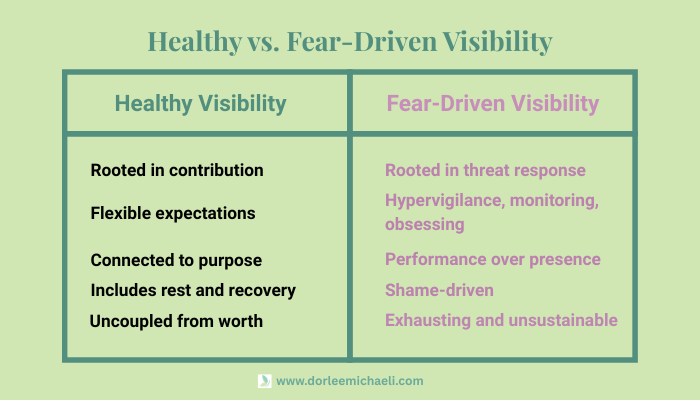
Healthy visibility expands your life.
Fear-driven visibility constricts it.
Integrating Safety and Visibility
Understanding the difference between healthy and fear-driven visibility matters.
Equally important is this:
The goal is not to eliminate activation around visibility.
The goal is to integrate it.
Integration sounds like:
- “I’m nervous, and I’m still showing up.”
- “My body is activated, and I can still contribute.”
- “This discomfort doesn’t mean I’m doing it wrong.”
This is what integration looks like, not fearlessness, but agency.
When visibility is grounded in safety, you get to choose how and when you show up.
Not because fear disappears, but because possibility grows alongside it.
No, the visibility double bind and imposter syndrome are different, though they often appear together.
Imposter syndrome says “I’m not good enough,” while the visibility double bind says “It isn’t safe to be seen.”
Imposter syndrome is about doubting your competence, while the visibility double bind is about your nervous system perceiving visibility as a threat. Both deserve support, but they require different kinds of healing; imposter syndrome needs cognitive reframing and competence validation, while the visibility double bind needs nervous system regulation and trauma-informed approaches.
The visibility double bind and social anxiety can overlap but are distinct experiences.
Social anxiety involves fear of social situations and being judged by others in everyday interactions. The visibility double bind specifically relates to professional visibility and being seen for your achievements or contributions.
Someone with the visibility double bind might be comfortable in social settings but freeze when asked to present their work or accept recognition.
The visibility double bind is rooted in how your nervous system learned to associate visibility with danger, often from childhood experiences where being seen led to criticism, unpredictable responses, or feeling unsafe.
Yes, absolutely. The visibility double bind is not about introversion.
Introverts can be comfortable with visibility when their nervous system feels safe. They simply may need more recovery time afterward.
The visibility double bind occurs when visibility triggers a threat response in your nervous system, causing you to shut down, over-prepare excessively, or avoid opportunities entirely.
Many introverts successfully step into visibility through nervous system regulation, micro-visibility practices, and creating the right conditions for their energy style.
The key is building internal safety, not changing your personality.
There’s no universal timeline for healing the visibility double bind because it depends on several factors: how long the pattern has been present, the depth of the nervous system response, whether you’re working with a therapist, and how consistently you practice nervous system regulation.
Some people notice shifts within weeks of starting micro-visibility practices, while others need months or years of trauma-informed therapy.
The goal isn’t to eliminate all nervousness around visibility, but to reach a place where you can feel nervous and still show up, what we call integration.
Progress often comes in small waves rather than linear improvement.
Healthy visibility is rooted in contribution, connected to your purpose, includes rest and recovery, and is uncoupled from your worth. It feels sustainable and expands your life.
Fear-driven visibility stems from a threat response and involves hypervigilance, monitoring, and obsessing over how you’re perceived. It prioritizes performance over presence, is driven by shame, and feels exhausting and unsustainable.
With healthy visibility, you choose when and how to show up based on what serves you and your work.
With fear-driven visibility, you’re either forcing yourself into the spotlight to prove your worth or avoiding it entirely because it feels dangerous.
Not everyone needs therapy to address the visibility double bind, but many people find it helpful, especially if the pattern is deeply rooted or significantly impacts their professional life.
If you can make progress with micro-visibility practices, nervous system regulation techniques, and self-compassion work on your own, that’s wonderful.
However, therapy becomes particularly valuable if visibility triggers intense activation (panic, shutdown, dissociation), if the pattern traces back to childhood trauma, or if you’ve tried self-help approaches without success.
EMDR and other trauma-informed therapies can help reprocess the memories and experiences that taught your nervous system that visibility equals danger.
A therapist can also provide the relational safety needed to practice being seen in a controlled, supportive environment.
A Gentle Closing Thought
The visibility double bind is not a flaw. It is a protective strategy shaped by past experiences and learned expectations.
As you begin to feel safer within yourself, visibility becomes less threatening.
You can take up space without feeling exposed. You are allowed to step into your full presence. You are allowed to be seen.
You deserve to take up space.
You deserve to be seen without fear.
You deserve a life where recognition and safety can coexist.
And you do not have to do this alone.
If This Post Resonated, Explore the Rest of the Series
This is Part 8 of the Imposter Syndrome Series for quiet high-achieving professionals.
References/Further Reading
REFERENCES & FURTHER READING
Brown, B. (2012). Daring Greatly: How the Courage to Be Vulnerable Transforms the Way We Live, Love, Parent, and Lead. Avery.
Clance, P. R., & Imes, S. A. (1978). The imposter phenomenon in high achieving women: Dynamics and therapeutic intervention. Psychotherapy: Theory, Research & Practice, 15(3), 241-247.
Dana, D. (2018). The Polyvagal Theory in Therapy: Engaging the Rhythm of Regulation. W.W. Norton & Company.
Dana, D. (2021). Anchored: How to Befriend Your Nervous System Using Polyvagal Theory. Sounds True.
Neff, K. D. (2003). Self-compassion: An alternative conceptualization of a healthy attitude toward oneself. Self and Identity, 2(2), 85-101.
Porges, S. W. (2011). The Polyvagal Theory: Neurophysiological Foundations of Emotions, Attachment, Communication, and Self-Regulation. W.W. Norton & Company.
Porges, S. W. (2017). The Pocket Guide to the Polyvagal Theory: The Transformative Power of Feeling Safe. W.W. Norton & Company.
Shapiro, F. (2018). Eye Movement Desensitization and Reprocessing (EMDR) Therapy: Basic Principles, Protocols, and Procedures (3rd ed.). Guilford Press.
Van der Kolk, B. (2014). The Body Keeps the Score: Brain, Mind, and Body in the Healing of Trauma. Penguin Books.





This names something so many quiet high achievers feel but rarely have language for. The distinction between imposter syndrome and the visibility double bind (competence vs. nervous-system safety) is compelling. I appreciate how you center safety rather than “confidence” as the real foundation for change. This is one of those pieces that stays with you and gently reframes years of self-judgment. Truly worth reading in full.
Thank you so much, Cheryl, for this thoughtful reflection. Naming the nervous system piece is exactly what I hoped would soften some of that long-held self-judgment. I really appreciate you taking the time to read and share how it landed.
Hello Dorlee,
Another knock-out message, as per your norm!
I would imagine there are so many people who prefer ‘being seen but not exposed,’ so that reference most definitely resonated with me. The angst associated with exposure that could potentially lead to criticism is real. I’ve felt it before.
I also love how you describe the nervous system’s protective strategies such as ‘foggy thinking’ or ‘going blank’ and how they are adaptive responses / protective strategies – so interesting. As one who doesn’t prefer public speaking, I can relate to those responses! (And did ‘not’ realize that preparing for a confident presentation would ‘not’ overcome a feeling of being unsafe.)
As such, your suggestion to ‘build safety through micro-visibility’ is brilliant – a small-step method to rewire safety. Not only does it sound effective, but it sounds do-able! I also liked your ‘regulate before you reveal’ tips, especially to ‘drop your shoulders’ and ‘ground your feet.’
Thank you, again, for such actionable and thoughtful insights!
Thanks so much, Jacqui, for your thoughtful reflection. I really appreciate how carefully you engaged with the ideas.
What you named about wanting to be seen without feeling exposed is such a common and very human tension. That fear of criticism is real, and the nervous system does not distinguish much between social threat and other forms of danger. So those foggy or blank moments truly are protective, not personal flaws.
I am especially glad the idea of micro visibility landed as doable. That was very intentional. Safety rarely comes from forcing confidence. It comes from repeated experiences of staying regulated while being just a little more seen.
Your point about preparation not resolving a felt sense of unsafety is such an important insight and one many people miss. Regulation has to come first.
Thanks again – it means a lot to know this post resonated in such a lived way.