

TL;DR: The Superwoman Pattern links your sense of worth to how much you carry for others, making rest feel dangerous and needs feel selfish. You look steady from the outside, but inside you’re running on empty. This post explains why this survival strategy once made sense, and what it takes to begin separating your value from your usefulness.
Last updated: April 22, 2026
You just said yes to another project you don’t have time for.
Again.
Your shoulders tighten.
Your calendar’s full.
Your to-do list is impossible. And somehow, you’re still the person everyone counts on to hold it all together.
To the outside world, you look steady and dependable.
Inside, you are exhausted.
This is the Superwoman Pattern.
It is one of the most draining expressions of imposter syndrome, especially for quiet high achievers who shoulder more than most people realize.
This post builds on the earlier parts of this series, including The Soloist Pattern, The Expert Trap, and The Natural Genius Trap, which explore how fear, competence, and identity intertwine for high achieving women. The Superwoman Pattern is different. It blends performance with emotional caretaking and involves carrying everything instead of simply doing everything well.
Let’s explore it with clarity and compassion.
What the Superwoman Pattern Really Is
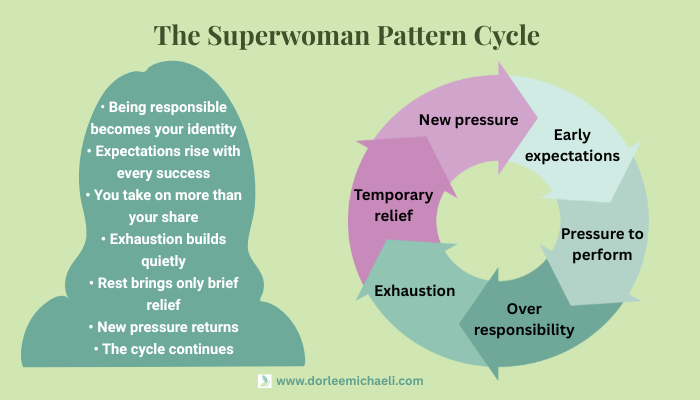
The Superwoman Pattern is a survival strategy that links worth with usefulness. It teaches you that you are safe when you are holding everything together and unsafe when you slow down, delegate, or express need.
At its core, the pattern says:
“I am valuable when I am responsible.”
People who fall into this form of superwoman pattern imposter syndrome often:
- take care of everyone before tending to themselves
- anticipate needs without being asked
- stay several steps ahead to prevent disappointment
- hide their own stress because they do not want to add pressure to others
- equate saying no with being unreliable
- feel guilty when resting or choosing themselves
The world often celebrates these qualities.
But on the inside, this pattern feels heavy and unrelenting.
Quick Self-Assessment
Do you recognize yourself here?
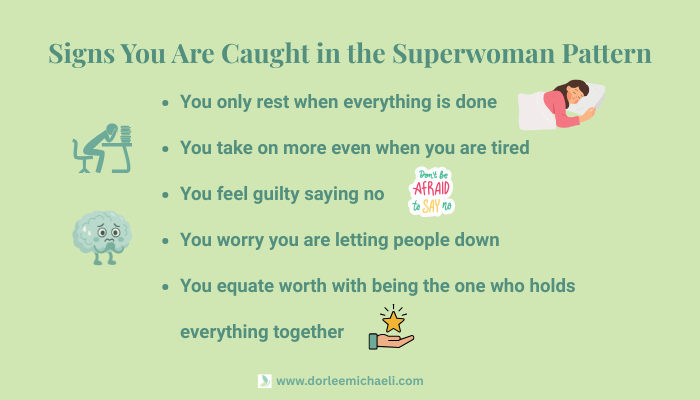
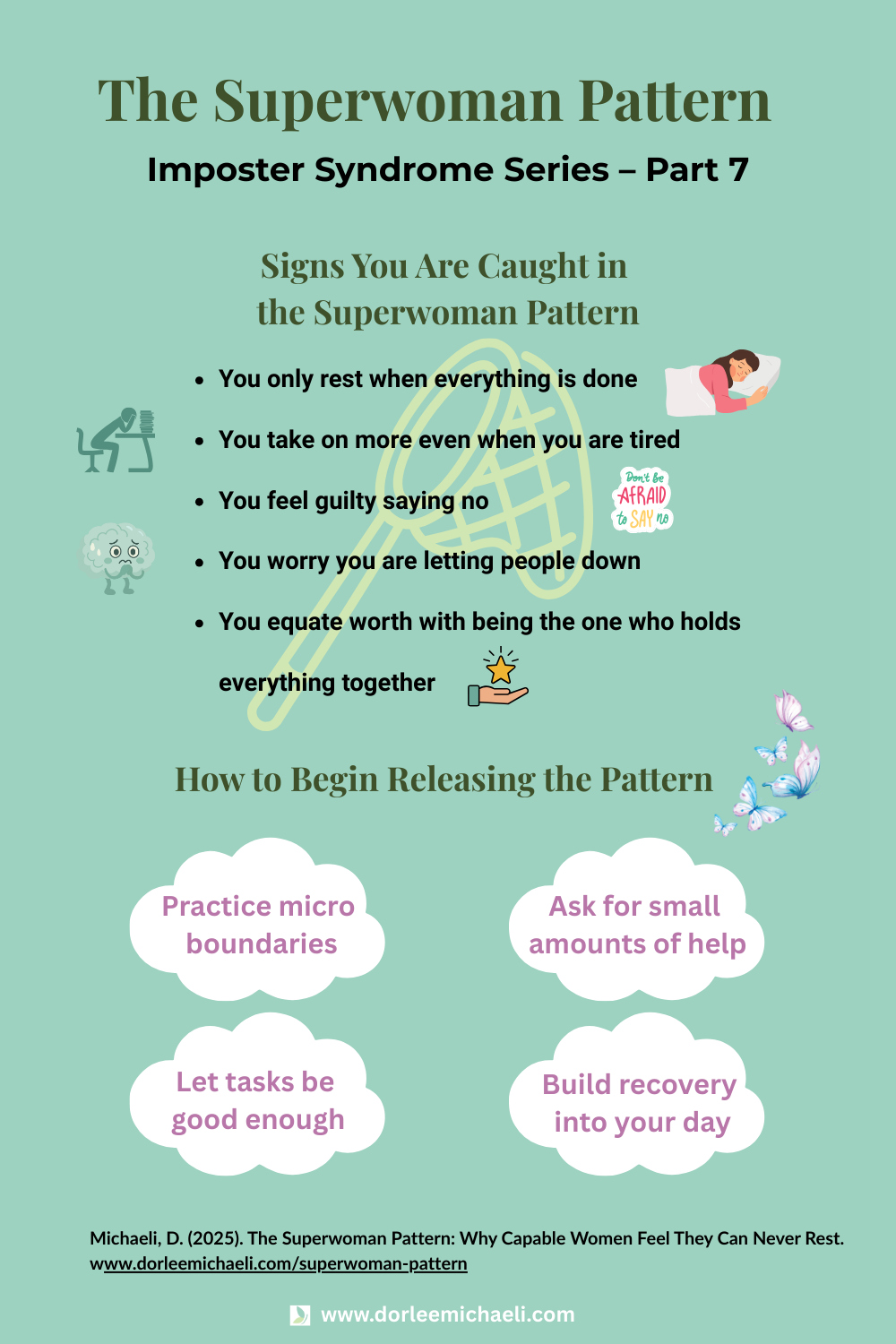
- You feel guilty when you rest, even when exhausted
- Saying no feels like letting people down
- You anticipate needs before anyone asks
- Delegating feels riskier than doing it yourself
- You hide your stress to avoid burdening others
If 3+ resonate, keep reading. This pattern is costing you more than you realize.
How the Superwoman Pattern Differs from Other Imposter Patterns
Because many imposter patterns overlap, clarity helps.
- The Expert Trap focuses on knowing everything
- The Natural Genius Trap focuses on doing everything easily
- The Soloist Pattern focuses on doing everything independently
- The Superwoman Pattern focuses on carrying everything flawlessly
and keeping everyone else steady
The Superwoman Pattern blends competence with emotional labor.
It is about holding a system rather than mastering a skill.
Where This Pattern Begins
This pattern does not come from personality.
It comes from childhood experiences that teach you that safety depends on staying capable and minimizing your own needs.
Many clients share early experiences such as:
- being the mature child in a tense or unpredictable home
- managing younger siblings or emotionally supporting adults
- receiving praise only when helpful, responsible, or self sufficient
- keeping the peace by staying agreeable
- feeling that their needs were too much or inconvenient
- being criticized or ignored when expressing emotion
A young nervous system learns:
- Productivity keeps the peace
- Being low maintenance earns affection
- Taking care of others prevents conflict
- Slowing down or needing help invites disappointment
These early lessons become the foundation of superwoman pattern imposter syndrome. Adulthood simply gives this pattern more places to grow.
How the Pattern Shows Up for Quiet High Achievers
Quiet high achievers often carry this pattern in subtle yet intense ways. They may:
- appear calm even when overwhelmed
- absorb the emotional weight of family, friendships, or work
- feel responsible for outcomes that are not theirs
- fear setting boundaries because it feels selfish
- anticipate needs before anyone asks
- struggle to ask for help because it feels unsafe or unfamiliar
- privately fear that slowing down will reveal inadequacy
- feel guilty for resting or choosing themselves
The world rewards them for being steady, organized, and supportive.
Inside, they may feel:
- tense
- overstimulated
- depleted
- anxious
- unseen
- never enough
A Real Life Example
To protect confidentiality, this story is a composite drawn from many clients.
A healthcare professional came to therapy feeling emotionally drained. She carried patient needs, team concerns, family responsibilities, emotional support for friends, and the mental load of running a home. People described her as exceptional.
She felt like she was barely surviving.
When she tried to slow down, her body tightened. Delegating felt unsafe. Saying no felt unacceptable. Rest produced guilt rather than relief. She believed that if she stopped, everything would fall apart.
Through trauma informed therapy and EMDR, she discovered that this pressure traced back to early experiences of supporting a parent and caring for a younger sibling. As a child, responsibility created stability. As an adult, it created exhaustion.
With time, she learned to separate her worth from what she carried.
She began to rest without earning it, ask for help in small ways, and accept support.
Her nervous system slowly softened.
Life became more spacious.
Why Slowing Down Feels Hard
Slowing down is not simply a choice.
It is a nervous system issue.
Your body remembers what your mind no longer needs to hold.
A nervous system shaped by the Superwoman Pattern believes:
Productivity equals stability
Stillness equals exposure
Rest equals vulnerability
Delegation equals risk
Asking for help equals disappointment
This same nervous system activation is what keeps the overthinking loop running; the mind scanning for threats, replaying decisions, unable to quiet even when the day is done.
This is why logic cannot shift the pattern.
The work involves safety, compassion, and repetition.
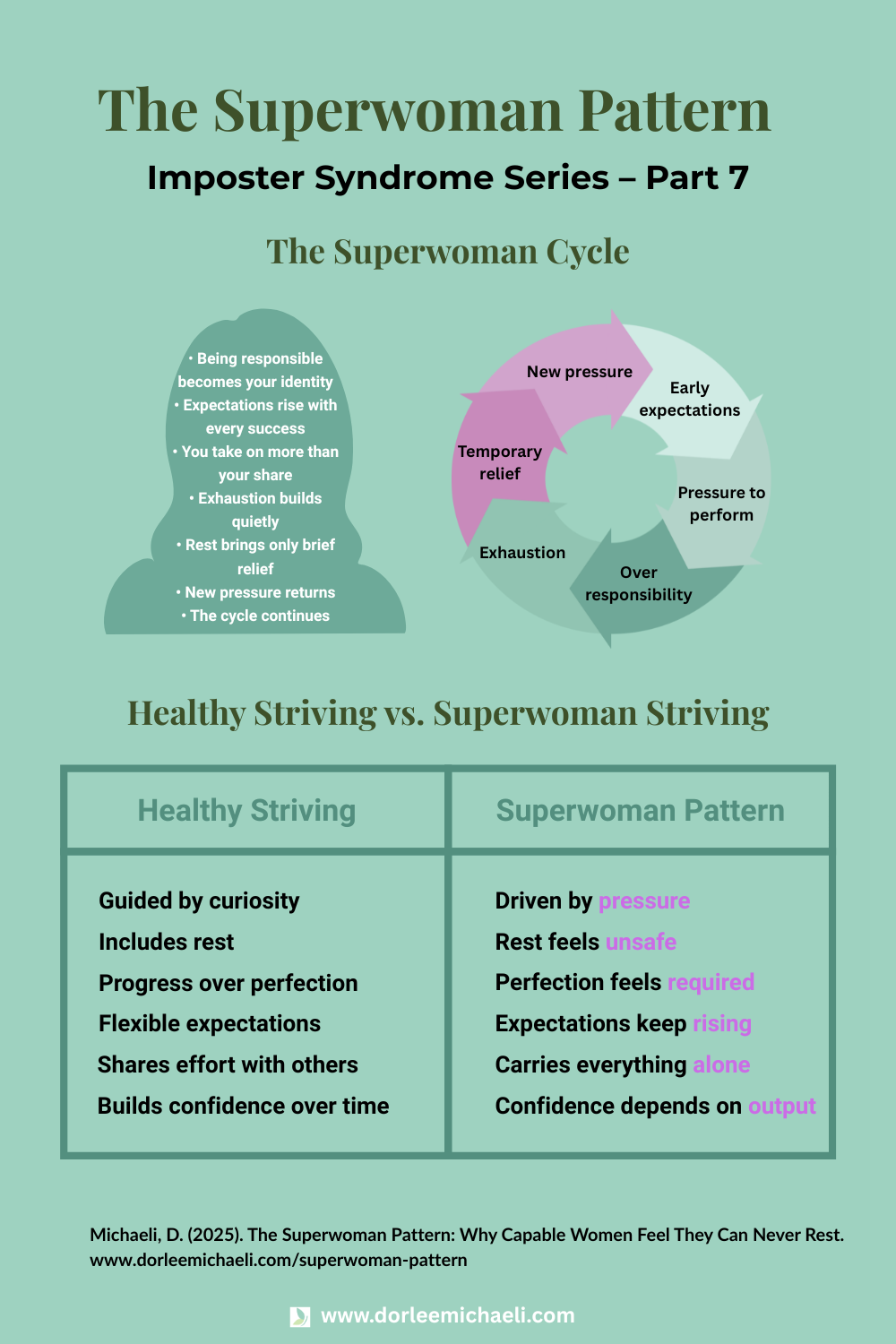
Healthy Striving vs the Superwoman Pattern
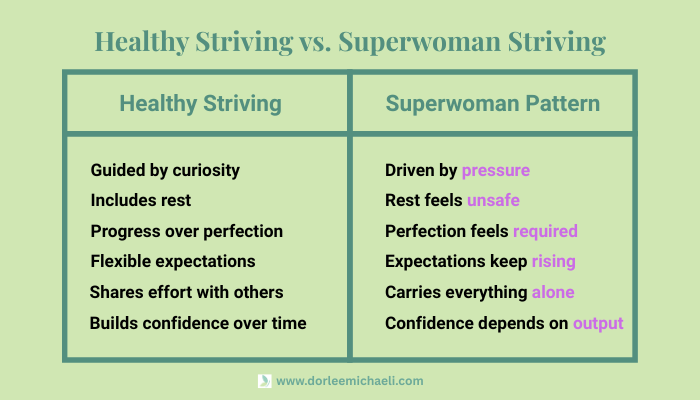
The behaviors may look similar. The emotional experience is not.
Healthy Striving
- grounded focus
- sense of choice
- room for rest
- progress that feels satisfying
- steady self worth
- shared responsibility
Superwoman Pattern
- constant pressure
- guilt around rest
- fear of being seen as incapable
- emotional exhaustion
- difficulty saying no
- internal resentment
Healthy striving expands your life.
The Superwoman Pattern constricts it.
How to Begin Shifting the Pattern
Healing requires gentleness, not pressure.
- Name the pressure
Naming interrupts the automatic loop.
For example: “I feel responsible for everything right now.”
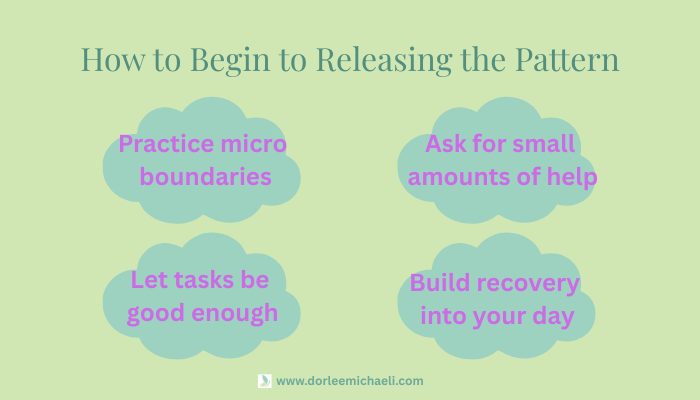
- Begin with micro boundaries
Choose something small and doable.
Examples:
- declining one optional task
- shortening emails
- reducing your availability slightly
- letting others take the lead occasionally
- Practice receiving small forms of support
Let someone else make a decision.
Say yes when someone offers help.
Allow a colleague to share responsibility.
Your nervous system needs these tiny experiences of safety.
- Rest without earning it
Start with very small increments.
Two slow breaths.
A five minute pause.
Sitting without multitasking.
You are practicing a new form of security.
- Offer compassion to the younger part of you
This part learned that being strong was the only way to feel safe.
It does not need correction. It needs warmth.
What to do next:
If this pattern feels familiar and you’re ready to shift it, book a free consultation.
We’ll explore whether EMDR therapy, an EMDR therapy intensive or trauma-informed counseling can help you rest without guilt, delegate without fear, and finally separate your worth from your usefulness.
Not ready yet?
Start with one micro-boundary this week. Pick the smallest possible thing to decline or delegate. Notice what comes up. That’s your nervous system speaking.
Closing Thoughts
The Superwoman Pattern is not a flaw.
It is an intelligent survival strategy that once kept you safe.
You learned to be capable because capability created stability.
You learned to be strong because vulnerability was not always supported.
You learned to carry everything because it made the world feel steadier.
You are allowed to outgrow that now.
You are allowed to rest.
You are allowed to receive.
You are allowed to be held.
You are allowed to be human.
Your worth has never been measured by how much you carry.
It has always lived in who you are.
When you move with less pressure and more compassion, life becomes more spacious.
And confidence becomes steady rather than fragile.
If this post resonated, explore the full Imposter Syndrome Series to better understand your patterns and learn gentle, practical ways to shift them.
This is Part 7 of the series for quiet, high-achieving professionals.
- Part 5: The Expert Trap: Why “Never Knowing Enough” Keeps You Stuck
- Part 6: The Natural Genius Trap: Why Struggle Feels Like a Failure
- Part 8: The Visibility Double Bind: When Being Seen Feels Unsafe
Frequently Asked Questions About the Superwoman Imposter Syndrome Pattern
No. Perfectionism focuses on flawless results.
The Superwoman Pattern focuses on holding everything together flawlessly while carrying the emotional weight of keeping everyone else steady.
A perfectionist refines a report until it’s perfect.
A Superwoman completes the report, handles the team dynamics, supports colleagues, manages the emotional tone, and hides her exhaustion, all at once.
Many quiet high-achievers fear that slowing down or asking for help will reveal that they’re not as capable as others believe them to be.
This fuels superwoman pattern imposter syndrome, the belief that your worth depends on being endlessly useful, responsible, and available.
Rest feels like evidence of inadequacy rather than a biological need, creating a cycle where you can never stop without feeling like you’re failing.
Slowing down isn’t simply a choice. It’s a nervous system issue. Your body remembers what your mind no longer needs to hold.
A nervous system shaped by the Superwoman Pattern learned early that productivity equals stability, stillness equals exposure, and rest equals vulnerability.
These associations formed when being capable created safety and reliability earned connection. Logic can’t shift this pattern because it lives in your body’s survival wiring.
The behaviors may look similar, but the emotional experience is completely different. Healthy striving feels grounded, leaves room for rest, includes a sense of choice, and generates steady self-worth.
The Superwoman Pattern feels like constant pressure, produces guilt around rest, creates internal resentment, and makes delegation feel risky.
Healthy striving expands your life. The Superwoman Pattern constricts it.
EMDR (Eye Movement Desensitization and Reprocessing) is a trauma-informed therapy that helps your brain and body reprocess overwhelming experiences so they no longer trigger the same fear-driven responses.
Many clients with the Superwoman Pattern find EMDR helpful in reducing the pressure to carry everything, making rest feel safer, and allowing support to feel possible.
It works at the level where these patterns were formed, often in childhood experiences of supporting a parent, caring for siblings, or learning that being “low-maintenance” earned affection.
References/Further Reading
Clance, P. R., and Imes, S. A. (1978). The Imposter Phenomenon in High Achieving Women: Dynamics and Therapeutic Intervention.
Neff, K. D. (2003). Self Compassion: An Alternative Conceptualization of a Healthy Attitude Toward Oneself.
Brown, B. (2012). Daring Greatly: How the Courage to Be Vulnerable Transforms the Way We Live, Love, Parent, and Lead.
Walker, P. (2013). Complex PTSD: From Surviving to Thriving.
Porges, S. W. (2011). The Polyvagal Theory.
EMDR International Association. Research Overview.
Published: November 30, 2025; Updated May 16 2026




This is such a compassionate and eye-opening breakdown of a pattern so many of us live inside without ever naming it. The way you describe the Superwoman Pattern feels like being gently seen, not judged. I love how you connect it back to early nervous system wiring. It makes everything click into place. Thank you for offering language, clarity, and hope for those of us who have been carrying far too much for far too long.
Thanks so much, Cheryl, for this thoughtful comment. So many women move through this pattern for years without realizing it is rooted in early nervous system learning rather than personal failure. I am glad the post helped make those links feel clearer and more compassionate. It means a lot to know the writing offered a sense of being understood rather than judged.
Beautifully written. The Superwoman Pattern is so often mislabeled as “strength,” when in reality it’s a survival strategy built on early lessons about safety, responsibility, and worth.
Your breakdown captures the emotional labor underneath the competence the part people rarely see.
So many quiet high achievers will feel recognized in this.
Thanks so much, Heather for this. That distinction matters.
What often gets praised as strength is usually a pattern someone built to stay safe and responsible long before they had any real choice.
Naming the emotional work underneath helps people understand their reactions with more compassion instead of criticism.
I’m grateful the post offers language for an experience so many quiet high achievers move through privately.
Oh my yes. Of course, I have my own version of this story. I bet almost everyone experiences this. Breathe
It is remarkable how many versions of this story exist, Sandra. The details differ, yet the pressure to carry more than our share shows up in so many lives. Naming it out loud is often the first moment of relief.
Hello Dorlee,
First of all, the EMDR therapy sounds amazingly revealing and practical, in that it not only uncovers the source of ‘fear, anxiety, etc.’ but also provides solutions. I love how it helps reprocess overwhelming experiences so they no longer trigger fear-driven responses.
This latest chapter in your robust series builds well on the others and shows how emotionally all-consuming being a superwoman can be. It seems that many leaders who have earned that title through a superwoman persona will ultimately suffer health and/or career consequences due to the unsustainable burden it causes.
That is, of course, unless they choose to go inward and do the work to make a healthy change.
One of the points you made about feeling guilty for saying ‘no’ made me nod my head. I think many of us have experienced that guilt over the course of our lives/careers. I know I have!
As well, the micro-boundaries suggestions you made are so helpful. Over time, those small steps will lead to big, sustainable changes and overall transformation.
Thank you for yet another in-depth and informative article! You provide such a meaningful service for your clients, helping them to liberate from stress to achieve life and career harmony!
Jacqui
Jacqui, I so appreciate your generous read and thoughtful reflection. You captured something central. Many high performers only realize the cost of the superwoman role once the nervous system starts signaling overload. EMDR can be powerful here because it works at the level where those patterns were formed, which is why even tiny boundaries start to feel doable instead of guilt producing. Thank you for your kind words.Thank you for your kind words. In many ways our work complements each other. We both help people release the strain they carry and take the next step toward their goals. It is a privilege to do this kind of work.
Recognising the subtle signs of the Superwoman pattern, such as people-pleasing and self-sacrifice, is a crucial step towards breaking free from the cycle of burnout and cultivating a healthier, more sustainable approach to personal and professional success…
So true, Cheryl. Recognizing the pattern with compassion is what makes space for a more sustainable way of moving through work and relationships.